1. writing structure

* introduction:
let the hypothesis clearly expressed
*body paragraphs(2~4):
give support ideas which could be further information, examples and the contrasting views
* conclusion:
should not be too long but brief and share the same view as the hypothesis mentioned in introduction
-------------------
2. The Raven -- Edgar Allan Poe
Once upon a midnight dreary, while I pondered, weak and weary,
Over many a quaint and curious volume of forgotten lore—
While I nodded, nearly napping, suddenly there came a tapping,
As of some one gently rapping, rapping at my chamber door.
"'Tis some visiter," I muttered, "tapping at my chamber door—
Only this and nothing more."
Over many a quaint and curious volume of forgotten lore—
While I nodded, nearly napping, suddenly there came a tapping,
As of some one gently rapping, rapping at my chamber door.
"'Tis some visiter," I muttered, "tapping at my chamber door—
Only this and nothing more."
*"The Raven" is a narrative poem by American writer Edgar Allan Poe. First published in January 1845, the poem is often noted for its musicality, stylized language, and supernatural atmosphere. It tells of a talking raven's mysterious visit to a distraught lover, tracing the man's slow fall into madness. The lover, often identified as being a student, is lamenting the loss of his love, Lenore. Sitting on a bust of Pallas, the raven seems to further instigate his distress with its constant repetition of the word "Nevermore". The poem makes use of a number of folk and classical references.
*Analysis
Poe wrote the poem as a narrative, without intentionally creating an allegory or falling into didacticism. The main theme of the poem is one of undying devotion.[9] The narrator experiences a perverse conflict between desire to forget and desire to remember. He seems to get some pleasure from focusing on loss.[10] The narrator assumes that the word "Nevermore" is the raven's "only stock and store", and, yet, he continues to ask it questions, knowing what the answer will be. His questions, then, are purposely self-deprecating and further incite his feelings of loss.[11] Poe leaves it unclear if the raven actually knows what it is saying or if it really intends to cause a reaction in the poem's narrator.[12] The narrator begins as "weak and weary," becomes regretful and grief-stricken, before passing into a frenzy and, finally, madness.[13] Christopher F. S. Maligec suggests the poem is a type of elegiac paraclausithyron, an ancient Greek and Roman poetic form consisting of the lament of an excluded, locked-out lover at the sealed door of his beloved.
*Alliteration(押頭韻) is the repetition of the same sounds or of the same kinds of sounds at the beginning of words or in stressed syllables of an English language phrase. Alliteration developed largely through poetry, in which it more narrowly refers to the repetition of a consonant in any syllables that, according to the poem's meter, are stressed,[1][2][3] as in James Thomson's verse "Come…dragging the lazy languid Line along". Another example is Peter Piper Picked a Peck of Pickled Peppers.
*But the fact is I was napping, and so gently you came rapping
And so faintly you came tapping, tapping at my chamber door,→onomatopoeia
*Poe's another work
The Philosophy of Composition
"The Philosophy of Composition" is an 1846 essay written by American writer Edgar Allan Poe that elucidates a theory about how good writers write when they write well. He concludes that length, "unity of effect" and a logical method are important considerations for good writing. He also makes the assertion that "the death... of a beautiful woman" is "unquestionably the most poetical topic in the world". Poe uses the composition of his own poem "The Raven" as an example. The essay first appeared in the April 1846 issue of Graham's Magazine. It is uncertain if it is an authentic portrayal of Poe's own method.
*"Unity of effect"
The essay states Poe's conviction that a work of fiction should be written only after the author has decided how it is to end and which emotional response, or "effect," he wishes to create, commonly known as the "unity of effect." Once this effect has been determined, the writer should decide all other matters pertaining to the composition of the work, including tone, theme, setting, characters, conflict, and plot.
------------------------
3. 浪漫派詩人→ with individualism, humanism, romanticism
- Ode to the West Wind--Percy Bysshe Shelly
→Some have interpreted the poem as the speaker lamenting his inability to directly help those in England owing to his being in Italy. At the same time, the poem expresses the hope that its words will inspire and influence those who read or hear it.[1] Perhaps more than anything else, Shelley wanted his message of reform and revolution spread, and the wind becomes the trope for spreading the word of change through the poet-prophet figure.
*some excerpt: (full content)
Drive my dead thoughts over the universe
Like wither'd leaves to quicken a new birth!→化作春泥更護花
If Winter comes, can Spring be far behind?
---------------------
4. narrative poetry→史詩
lyrical poetry→抒情詩
---------------------
5."Bartleby, the Scrivener
"Bartleby, the Scrivener: A Story of Wall Street" is a short story by the American writer Herman Melville (1819–1891). It first appeared anonymously in two parts in the November and December 1853 editions of Putnam's Magazine, and was reprinted with minor textual alterations in his The Piazza Tales in 1856.
*some excerpts:
Dead letters! does it not sound like dead men? Conceive a man by nature and misfortune prone to a pallid hopelessness, can any business seem more fitting to heighten it than that of continually handling these dead letters, and assorting them for the flames? Sometimes from out the folder paper the pale clerk takes a ring—the finger it was meant for, perhaps, moulders in the grave; a bank- note sent in swiftest charity—he whom it would relieve, nor eats nor hungers any more…on errands of life, these letters speed to death. Ah, Bartleby! Ah, humanity!
----------------------
6. parable of the Good Samaritan

The parable of the Good Samaritan is a parable told by Jesus and is mentioned in only one of the gospels of the New Testament. According to the Gospel of Luke, a traveler (who may or may not have been a Jew [1]) is beaten, robbed, and left half dead along the road. First a priest and then a Levite come by, but both avoid the man. Finally, a Samaritan comes by. Samaritans and Jewsgenerally despised each other, but the Samaritan helps the injured man. Jesus is described as telling the parable in response to a question regarding the identity of the "neighbour", who Leviticus says should be loved.
*Portraying a Samaritan in a positive light would have come as a shock to Jesus's audience.[2] It is typical of his provocative speech in which conventional expectations are inverted.[2]
*Some Christians, such as Augustine, have interpreted the parable allegorically, with the Samaritan representing Jesus Christ, who saves the sinful soul.[3] Others, however, discount this allegory as unrelated to the parable's original meaning[3] and see the parable as exemplifying the ethics of Jesus.[4]
*The parable has inspired painting, sculpture, poetry, and film. The colloquial phrase "good Samaritan", meaning someone who helps a stranger, derives from this parable, and many hospitals and charitable organizations are named after the Good Samaritan.
------------------------
8. parable (人間的小故事,講天國的大道理)
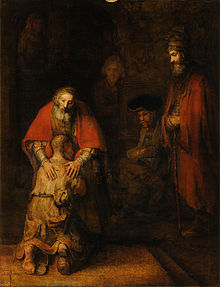
A parable is a succinct, didactic story, in prose or verse, which illustrates one or more instructive lessons or principles. It differs from a fable in that fables employ animals, plants, inanimate objects, or forces of nature as characters, whereas parables have human characters. A parable is a type of analogy.[1]
Some scholars of the canonical gospels and the New Testament apply the term "parable" only to the parables of Jesus,[2][3] though that is not a common restriction of the term. Parables such as "The Prodigal Son" are central to Jesus' teaching method in both the canonical narratives and the apocrypha.
-----------------------
9.A Beautiful Mind (film)

A biopic of the meteoric rise of John Forbes Nash Jr., a math prodigy able to solve problems that baffled the greatest of minds. And how he overcame years of suffering through schizophrenia to win the Nobel Prize.
------------------------10.春風化雨片:
----------------------
11. National Treasure(國家寶藏)

Benjamin Franklin Gates descends from a family of treasure-seekers who've all hunted for the same thing: a war chest hidden by the Founding Fathers after the Revolutionary War. Ben's close to discovering its whereabouts, as is his competition, but the FBI is also hip to the hunt.
---------------------
12."Ode on a Grecian Urn"
* He was inspired to write the poem after reading two articles by English artist and writer Benjamin Haydon. Keats was aware of other works on classical Greek art, and had first-hand exposure to the Elgin Marbles, all of which reinforced his belief that classical Greek art was idealistic and captured Greek virtues, which forms the basis of the poem.
→
----------------------------
13. The Tell Tale Heart

"The Tell-Tale Heart" is a short story by Edgar Allan Poe first published in 1843. It is told by an unnamed narrator who endeavors to convince the reader of his sanity, while describing a murder he committed. (The victim was an old man with a filmy "vulture-eye", as the narrator calls it.) The murder is carefully calculated, and the murderer hides the body by dismembering it and hiding it under the floorboards. Ultimately the narrator's guilt manifests itself in the form of the sound—possibly hallucinatory—of the old man's heart still beating under the floorboards.
*It is unclear what relationship, if any, the old man and his murderer share. The narrator denies having any feelings of hatred or resentment for the man. He states: 'I loved the old man! He had never wronged me! He had never given me insult!'. He also denies the assumption that he killed for greed: 'Object there was none.', 'For his gold I had no desire.' It has been suggested that the old man is a father figure, the narrator's landlord, or that the narrator works for the old man as a servant, and that perhaps his "vulture-eye" represents some sort of veiled secret, or power. The ambiguity and lack of details about the two main characters stand in stark contrast to the specific plot details leading up to the murder.
→tales of horror which frequently make use of psychological abnormalities
----------------------
14.
- The Sound of Waves (潮騒 )

The Sound of Waves is a 1954 novel by the Japanese author Yukio Mishima. It's a coming of age story detailing the maturity of protagonist Shinji and his romance with Hatsue, the beautiful daughter of the wealthy ship owner Terukichi. For this book Mishima was awarded the Shincho Prize from Shinchosha Publishing in 1954. It was adapted to film on five separate occasions.
- The Temple of Dawn (暁の寺)
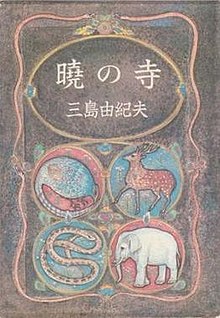
The Temple of Dawn is the third novel in the Sea of Fertility tetralogy by the Japanese writer Yukio Mishima. For this as for the other novels in the series, Mishima travelled to various places to conduct research, including Wat Arun inBangkok, Thailand.[1]
*plot:
The lawyer Honda visits Thailand on a business trip and encounters a young girl whom he believes to be his schoolfriend's second reincarnation. Eleven years later she travels to Japan to study and he befriends her in the hope of learning more. The main narrative takes place between 1941 and 1952. The last chapter is set in 1967
- The Temple of the Golden Pavilion (金閣寺)
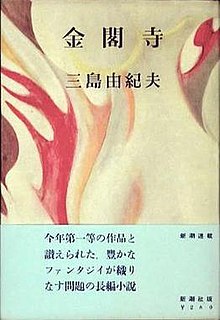
The Temple of the Golden Pavilion is a novel by the Japanese author Yukio Mishima. It was published in 1956 and translated into English by Ivan Morris in 1959.
*plot:
The novel is loosely based on the burning of the Reliquary (or Golden Pavilion) of Kinkaku-ji in Kyoto by a young Buddhist acolyte in 1950. The pavilion, dating from before 1400, was a national monument that had been spared destruction many times throughout history, and the arson shocked Japan. The story is narrated by Mizoguchi, the disturbed acolyte in question, who is afflicted with an ugly face and a stutter, and who recounts his obsession with beauty and the growth of his urge to destroy it. The novel also includes one of Mishima's most memorable characters, Mizoguchi's club-footed, deeply cynical friend Kashiwagi, who gives his own highly individual twist to various Zen parables (koan).
-------------------
15.Yukio Mishima
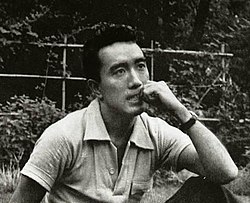
Yukio Mishima is a Japanese author, poet, playwright, actor, and film director. Mishima is considered one of the most important Japanese authors of the 20th century; he was nominated three times for the Nobel Prize in Literature
*His avant-garde work displayed a blending of modern and traditional aesthetics that broke cultural boundaries, with a focus on sexuality, death, and political change.[3] He is also remembered for his ritual suicide by seppuku after a failed coup d'étatattempt, known as the "Mishima Incident".


