1. chivalry/knight/ King Arthur/ Round Table/ Holy Grail/ Chalice

*feuldulism

Feudalism was a set of legal and military customs in medieval Europe that flourished between the 9th and 15th centuries. Broadly defined, it was a system for structuring society around relationships derived from the holding of land in exchange for service or labour.
*catholicism
Catholicism is used as a broad term for describing specific traditions in the Christian churches in theology and doctrine, liturgy, ethics and spirituality.
In this sense, it is to be distinguished from the sense in which it denotes Christians and churches, western and eastern, that are in full communion with the Holy See, and that are commonly called the Catholic Church or Roman Catholic Church.[1]
In the sense of indicating historical continuity of faith and practice from the first millennium, the term "Catholicism" is at times employed to mark a contrast to Protestantism, which tends to look solely to the Bible as interpreted on the principles of the 16th-century Protestant Reformation as its ultimate standard.[2]
*chivalry
Chivalry, or the chivalric code, is a code of conduct associated with the medieval institution of knighthood. Chivalry arose from an idealised German custom.[1] It developed first in the north of France among horse soldiers who served in Charlemagne′s heavy cavalry.[2] It was originally conceived of as an aristocratic warrior code — the term derives from the French term chevalerie, meaning horse soldiery[3] — involving gallantry, individual training, and service to others. Over time its meaning has been refined to emphasise more ideals such as the knightly virtues of honour, courtly love, courtesy, and less martial aspects of the tradition.
---------------------------
2.The Faerie Queene


The Faerie Queene found political favour with Elizabeth I and was consequently a success, to the extent that it became Spenser's defining work. The poem found such favour with the monarch that Spenser was granted a pension for life amounting to fifty pounds a year, though there is no evidence that Elizabeth I read any of the poem.[2]
---------------------
3 icon→leadership
.An icon is a religious work of art, most commonly a painting, from Eastern Christianity and in certain Eastern Catholic churches. More broadly the term is used in a wide number of contexts for an image, picture, or representation; it is a sign or likeness that stands for an object by signifying or representing it either concretely or by analogy, as in semiotics; by extension, icon is also used, particularly in modern culture, in the general sense of symbol — i.e. a name, face, picture, edifice or even a person readily recognized as having some well-known significance or embodying certain qualities: one thing, an image or depiction, that represents something else of greater significance through literal or figurative meaning, usually associated with religious, cultural, political, or economic standing.
.An icon is a religious work of art, most commonly a painting, from Eastern Christianity and in certain Eastern Catholic churches. More broadly the term is used in a wide number of contexts for an image, picture, or representation; it is a sign or likeness that stands for an object by signifying or representing it either concretely or by analogy, as in semiotics; by extension, icon is also used, particularly in modern culture, in the general sense of symbol — i.e. a name, face, picture, edifice or even a person readily recognized as having some well-known significance or embodying certain qualities: one thing, an image or depiction, that represents something else of greater significance through literal or figurative meaning, usually associated with religious, cultural, political, or economic standing.
----------------------
4.The Middle Age→ Renaissance→ Neoclassicism→Romanticism→Victorianism
(faith) (reason) (faith) (reason) (faith)
----------------------
5.Rembrandt

Rembrandt Harmenszoon van Rijn was aDutch painter and etcher. He is generally considered one of the greatest painters and printmakers in European art and the most important in Dutch history.[2] His contributions to art came in a period of great wealth and cultural achievement that historians call theDutch Golden Age when Dutch Golden Age painting, although in many ways antithetical to the Baroque style that dominated Europe, was extremely prolific and innovative, and gave rise to important new genres in painting.
*Rembrandt lighting is a lighting technique that is used in studio portrait photography. It can be achieved using one light and a reflector, or two lights, and is popular because it is capable of producing images which appear both natural and compelling with a minimum of equipment. Rembrandt lighting is characterized by an illuminated triangle under the eye of the subject on the less illuminated side of the face. It is named for the Dutch painter Rembrandt, who often used this type of lighting.
*
-----------------------
6. impressionism
*Impressionist painting characteristics include relatively small, thin, yet visible brush strokes, open composition, emphasis on accurate depiction of light in its changing qualities (often accentuating the effects of the passage of time), ordinary subject matter, inclusion of movement as a crucial element of human perception and experience, and unusual visual angles. The development of Impressionism in the visual arts was soon followed by analogous styles in other media that became known asimpressionist music and impressionist literature.

*Monet
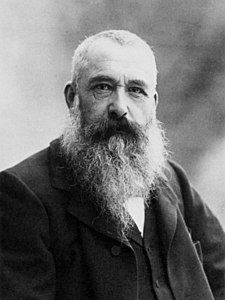
Oscar-Claude Monet was a founder of French Impressionist painting, and the most consistent and prolific practitioner of the movement's philosophy of expressing one's perceptions before nature, especially as applied to plein-air landscape painting
→Monet's ambition of documenting the French countryside led him to adopt a method of painting the same scene many times in order to capture the changing of light and the passing of the seasons.
-------------------------
The painting may be more properly titled by its long since forgotten name The Company of captain Frans Banning Cocq and lieutenant Willem van Ruytenburch preparing to march out. In the 18th century the painting became known as the Night Watch. It is prominently displayed in the Rijksmuseum, Amsterdam, the Netherlands, as the best known painting in its collection. The Night Watch is one of the most famous paintings in the world.

----------------------
8.Twelfth Night is a festival, in some branches of Christianity, marking the coming of the Epiphany and concluding the Twelve Days of Christmas.
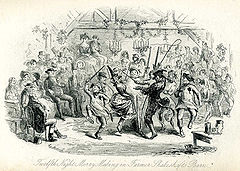
It is defined by the Shorter Oxford English Dictionary as "the evening of the fifth of January, preceding Twelfth Day, the eve of the Epiphany, formerly the last day of the Christmas festivities and observed as a time of merrymaking".[1] There is some confusion, however, as to which night is Twelfth Night.[2] The older tradition of Twelfth Night being on the eve of 5 January stems from the medieval practice of the day beginning at sunse, rather than at midnight as it does now. Thus Twelfth Night falls on the night of 5 January nowadays.
Epiphany or Theophany which traditionally falls on January 6, is a Christian feast day that celebrates the revelation of God the Son as a human being in Jesus Christ. Western Christians commemorate principally (but not solely) the visit of the Magi to the Baby Jesus, and thus Jesus' physical manifestation to the Gentiles. Eastern Christians commemorate the baptism of Jesus in the Jordan River, seen as his manifestation to the world as the Son of God.
-------------------
9.She's the Man

She's the Man is a 2006 American romantic comedy film directed by Andy Fickman, inspired by William Shakespeare's play Twelfth Night. The film stars Amanda Bynes, Channing Tatum, Laura Ramsey, and Vinnie Jones.
*The film centers around teenager Viola Hastings who enters her brother's school in his place, pretending to be male, in order to play with the boys' soccer team.
--------------------------
Word
1.obsession (no reason desire)
→the boy's obsession on someone
2.commencement 畢業典禮
(receive academic degree)
3.hooding ceremony
→ a special recognition ceremony for doctoral degree


