1.The tell tell heart

"The Tell-Tale Heart" is a short story by Edgar Allan Poe first published in 1843. It is told by an unnamed narrator who endeavors to convince the reader of his sanity, while describing a murder he committed. (The victim was an old man with a filmy "vulture-eye", as the narrator calls it.) The murder is carefully calculated, and the murderer hides the body by dismembering it and hiding it under the floorboards. Ultimately the narrator's guilt manifests itself in the form of the sound—possiblyhallucinatory—of the old man's heart still beating under the floorboards.
THE TELL-TALE HEART.
——
BY EDGAR A. POE.
——
Art is long and Time is fleeting,
And our hearts, though stout and brave,
Still, like muffled drums, are beating
Funeral marches to the grave. Longfellow.
Still, like muffled drums, are beating
Funeral marches to the grave. Longfellow.
——
-----------------------------------------------------
Themes
1.Sin, Knowledge, and the Human Condition
2.The Nature of Evil
3.Identity and Society
Motifs
1.Civilization Versus the Wilderness (village v.s. forest)
2.Night Versus Day
3.Evocative Names
Symbols
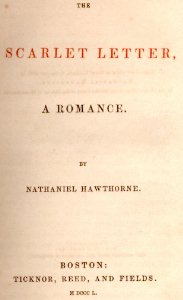
1.The Scarlet Letter
2.The Meteor
3.Pearl
*character
1.Hester Prynne - Hester is the book’s protagonist and the wearer of the scarlet letter that gives the book its title.
2.Roger Chillingworth - “Roger Chillingworth” is actually Hester’s husband in disguise.
3.Reverend Arthur Dimmesdale - Dimmesdale is a young man who achieved fame in England as a theologian and then emigrated to America. In a moment of weakness, he and Hester became lovers.
* political allegory: "... you may rise in the world, without the help of your kinsman, Major Molineux."
→ 不在尋求英國從軍的親戚
----------------------------------------------------------

Salem's Most Visited Museum
Twenty innocent people were put to death
during the Witch Hysteria of 1692.
History made them famous...
we make them real
-----------------------------------------------------
4) A Streetcar Named Desire 慾望街車

A Streetcar Named Desire is a 1951 American film adaptation of the Pulitzer Prize-winning 1947 play of the same name by Tennessee Williams. Williams collaborated with Oscar Saul on the screenplay and Elia Kazan, who directed the stage production, went on to direct the film. Marlon Brando, Kim Hunter, and Karl Malden, all members of the original Broadway cast, reprised their roles for the film. Vivien Leigh, who had appeared in the London theatre production, was brought in for the film version in lieu of Jessica Tandy, who had created the part of Blanche DuBois on Broadway.
*Gone with the Wind (亂世佳人)
 Gone with the Wind is a 1939 American epic historical romance film adapted from Margaret Mitchell's Pulitzer-winning 1936 novel. It was produced by David O. Selznick of Selznick International Pictures and directed by Victor Fleming. Set in the 19th-century American South, the film tells the story of Scarlett O'Hara, the strong-willed daughter of a Georgia plantation owner, from her romantic pursuit of Ashley Wilkes, who is married to his cousin, Melanie Hamilton, to her marriage to Rhett Butler. Set against the backdrop of the American Civil War and Reconstruction era, the story is told from the perspective of white Southerners. The leading roles are portrayed by Vivien Leigh (Scarlett), Clark Gable (Rhett), Leslie Howard (Ashley), and Olivia de Havilland (Melanie).
-----------------------------------------------------
5) Self-Reliance (天助自助者)
 Self-Reliance is an essay written by American transcendentalist philosopher and essayist Ralph Waldo Emerson. It contains the most thorough statement of one of Emerson's recurrent themes, the need for each individual to avoid conformity and false consistency, and follow his or her own instincts and ideas. It is the source of one of Emerson's most famous quotations: "A foolish consistency is the hobgoblin of little minds, adored by little statesmen and philosophers and divines."[1] This essay is an analysis into the nature of the “aboriginal self on which a universal reliance may be grounded.”
Ralph Waldo Emerson (May 25, 1803 – April 27, 1882) was an American essayist, lecturer, and poet, who led the Transcendentalist movement of the mid-19th century. He was seen as a champion of individualism and a prescient critic of the countervailing pressures of society, and he disseminated his thoughts through dozens of published essays and more than 1,500 public lectures across the United States.
* individual self-culture
* valuing individual rights
* self-reliance
-----------------------------------------------------
"Nature" is an essay written by Ralph Waldo Emerson, and published by James Munroe and Company in 1836. In this essay Emerson put forth the foundation of transcendentalism, a belief system that espouses a non-traditional appreciation of nature
Twenty innocent people were put to death
during the Witch Hysteria of 1692.
History made them famous...
we make them real
-----------------------------------------------------
4) A Streetcar Named Desire 慾望街車
A Streetcar Named Desire is a 1951 American film adaptation of the Pulitzer Prize-winning 1947 play of the same name by Tennessee Williams. Williams collaborated with Oscar Saul on the screenplay and Elia Kazan, who directed the stage production, went on to direct the film. Marlon Brando, Kim Hunter, and Karl Malden, all members of the original Broadway cast, reprised their roles for the film. Vivien Leigh, who had appeared in the London theatre production, was brought in for the film version in lieu of Jessica Tandy, who had created the part of Blanche DuBois on Broadway.
*Gone with the Wind (亂世佳人)
Gone with the Wind is a 1939 American epic historical romance film adapted from Margaret Mitchell's Pulitzer-winning 1936 novel. It was produced by David O. Selznick of Selznick International Pictures and directed by Victor Fleming. Set in the 19th-century American South, the film tells the story of Scarlett O'Hara, the strong-willed daughter of a Georgia plantation owner, from her romantic pursuit of Ashley Wilkes, who is married to his cousin, Melanie Hamilton, to her marriage to Rhett Butler. Set against the backdrop of the American Civil War and Reconstruction era, the story is told from the perspective of white Southerners. The leading roles are portrayed by Vivien Leigh (Scarlett), Clark Gable (Rhett), Leslie Howard (Ashley), and Olivia de Havilland (Melanie).
-----------------------------------------------------
5) Self-Reliance (天助自助者)
Self-Reliance is an essay written by American transcendentalist philosopher and essayist Ralph Waldo Emerson. It contains the most thorough statement of one of Emerson's recurrent themes, the need for each individual to avoid conformity and false consistency, and follow his or her own instincts and ideas. It is the source of one of Emerson's most famous quotations: "A foolish consistency is the hobgoblin of little minds, adored by little statesmen and philosophers and divines."[1] This essay is an analysis into the nature of the “aboriginal self on which a universal reliance may be grounded.”
Ralph Waldo Emerson (May 25, 1803 – April 27, 1882) was an American essayist, lecturer, and poet, who led the Transcendentalist movement of the mid-19th century. He was seen as a champion of individualism and a prescient critic of the countervailing pressures of society, and he disseminated his thoughts through dozens of published essays and more than 1,500 public lectures across the United States.
* individual self-culture
* valuing individual rights
* self-reliance
-----------------------------------------------------

Within the essay, Emerson divides nature into four usages: Commodity, Beauty, Language and Discipline. These distinctions define the ways by which humans use nature for their basic needs, their desire for delight, their communication with one another and their understanding of the world.[3] Emerson followed the success of Nature with a speech, "The American Scholar", which together with his previous lectures laid the foundation for transcendentalism and his literary career.
*The essay consists of eight sections: Nature, Commodity, Beauty, Language, Discipline,Idealism, Spirit and Prospects.
*I WANDERED LONELY AS A CLOUD --- William Wordsworth
 I wandered lonely as a cloud 孤獨流浪我似雲
That floats on high o'er vales and hills, 飄過溪谷和高山,
When all at once I saw a crowd, 驟然看見一大群,
A host of golden daffodils; 簇簇金色的水仙;
Beside the lake, beneath the trees, 在湖畔在樹林下,
Fluttering and dancing in the breeze. 迎著風抖擻起舞。
Continuous as the stars 綿延不絕如繁星
that shine and twinkle on the Milky Way, 在銀河閃爍發光,
They stretched in never-ending line 伸展成一條長線
along the margin of a bay: 沿著湖水的邊緣:
Ten thousand saw I at a glance, 一眼瞧見千萬朵
tossing their heads in sprightly dance. 搖著頭快樂翻舞
The waves beside them danced; but they 湖水伴著花起舞
Out-did the sparkling waves in glee: 但花比水波還樂:
A poet could not but be gay, 詩人高興都不及,
in such a jocund company: 有歡樂花海相伴:
I gazed - and gazed - but little thought 凝視再三未及思
what wealth the show to me had brought: 盛景於我如財富:
For oft, when on my couch I lie 我經常橫躺小床
In vacant or in pensive mood, 放空心情或沈思,
They flash upon that inward eye 心眼裡花海乍現
Which is the bliss of solitude; 此誠獨處的福報;
And then my heart with pleasure fills, 心頭即湧滿歡欣,
And dances with the daffodils. 伴著水仙花共舞。
華茲華斯把詩定義為: “spontaneous overflow
of powerful feelings recollected in tranquility”。
這首 “I wandered lonely as a cloud”,正是這個主張的
現身說法。這首詩的前三節描述看到一大片水仙花,
心中感動,不自覺引起強烈的感情回應。最後一節
說的是:夜深人靜,日間那一幕花海搖曳的景象,
重回眼前,化作詩意,激起無限歡愉。
這就是詩的過程,也是詩的意境。
-----------------------------------------------------
"The American Scholar" was a speech given by Ralph Waldo Emerson on August 31, 1837, to the Phi Beta Kappa Society at Cambridge, Massachusetts.
*Emerson uses Transcendentalist and Romantic views to get his points across by explaining a true American scholar's relationship to nature. There are a few key points he makes that flesh out this vision:
- We are all fragments, "as the hand is divided into fingers", of a greater creature, which is mankind itself, "a doctrine ever new and sublime."
- An individual may live in either of two states. In one, the busy, "divided" or "degenerate" state, he does not "possess himself" but identifies with his occupation or a monotonous action; in the other, "right" state, he is elevated to "Man", at one with all mankind.
- To achieve this higher state of mind, the modern American scholar must reject old ideas and think for him or herself, to become "Man Thinking" rather than "a mere thinker, or still worse, the parrot of other men's thinking", "the victim of society", "the sluggard intellect of this continent".
- "The American Scholar" has an obligation, as "Man Thinking", within this "One Man" concept, to see the world clearly, not severely influenced by traditional/historical views, and to broaden his understanding of the world from fresh eyes, to "defer never to the popular cry."
-
The scholar's education consists of three influences:
- I. Nature as the most important influence on the mind
- II. The Past manifest in books
- III. Action and its relation to experience
- The last, unnumbered part of the text is devoted to Emerson's view on the "Duties" of the American Scholar who has become the "Man Thinking."
----------------------------------------------------------
Word:
1) liquid paper: 立可白
2) bleach : 漂白水 (粉)
3) lonely/ alone: 被丟下
*solitude: solo (獨處)
*I WANDERED LONELY AS A CLOUD --- William Wordsworth
I wandered lonely as a cloud 孤獨流浪我似雲
That floats on high o'er vales and hills, 飄過溪谷和高山,
When all at once I saw a crowd, 驟然看見一大群,
A host of golden daffodils; 簇簇金色的水仙;
Beside the lake, beneath the trees, 在湖畔在樹林下,
That floats on high o'er vales and hills, 飄過溪谷和高山,
When all at once I saw a crowd, 驟然看見一大群,
A host of golden daffodils; 簇簇金色的水仙;
Beside the lake, beneath the trees, 在湖畔在樹林下,
Fluttering and dancing in the breeze. 迎著風抖擻起舞。
Continuous as the stars 綿延不絕如繁星
that shine and twinkle on the Milky Way, 在銀河閃爍發光,
They stretched in never-ending line 伸展成一條長線
Continuous as the stars 綿延不絕如繁星
that shine and twinkle on the Milky Way, 在銀河閃爍發光,
They stretched in never-ending line 伸展成一條長線
along the margin of a bay: 沿著湖水的邊緣:
Ten thousand saw I at a glance, 一眼瞧見千萬朵
tossing their heads in sprightly dance. 搖著頭快樂翻舞
The waves beside them danced; but they 湖水伴著花起舞
Out-did the sparkling waves in glee: 但花比水波還樂:
A poet could not but be gay, 詩人高興都不及,
in such a jocund company: 有歡樂花海相伴:
I gazed - and gazed - but little thought 凝視再三未及思
what wealth the show to me had brought: 盛景於我如財富:
For oft, when on my couch I lie 我經常橫躺小床
In vacant or in pensive mood, 放空心情或沈思,
They flash upon that inward eye 心眼裡花海乍現
Which is the bliss of solitude; 此誠獨處的福報;
And then my heart with pleasure fills, 心頭即湧滿歡欣,
And dances with the daffodils. 伴著水仙花共舞。
華茲華斯把詩定義為: “spontaneous overflow
of powerful feelings recollected in tranquility”。
這首 “I wandered lonely as a cloud”,正是這個主張的
現身說法。這首詩的前三節描述看到一大片水仙花,
心中感動,不自覺引起強烈的感情回應。最後一節
說的是:夜深人靜,日間那一幕花海搖曳的景象,
重回眼前,化作詩意,激起無限歡愉。
這就是詩的過程,也是詩的意境。
-----------------------------------------------------
"The American Scholar" was a speech given by Ralph Waldo Emerson on August 31, 1837, to the Phi Beta Kappa Society at Cambridge, Massachusetts.
*Emerson uses Transcendentalist and Romantic views to get his points across by explaining a true American scholar's relationship to nature. There are a few key points he makes that flesh out this vision:
- We are all fragments, "as the hand is divided into fingers", of a greater creature, which is mankind itself, "a doctrine ever new and sublime."
- An individual may live in either of two states. In one, the busy, "divided" or "degenerate" state, he does not "possess himself" but identifies with his occupation or a monotonous action; in the other, "right" state, he is elevated to "Man", at one with all mankind.
- To achieve this higher state of mind, the modern American scholar must reject old ideas and think for him or herself, to become "Man Thinking" rather than "a mere thinker, or still worse, the parrot of other men's thinking", "the victim of society", "the sluggard intellect of this continent".
- "The American Scholar" has an obligation, as "Man Thinking", within this "One Man" concept, to see the world clearly, not severely influenced by traditional/historical views, and to broaden his understanding of the world from fresh eyes, to "defer never to the popular cry."
- The scholar's education consists of three influences:
- I. Nature as the most important influence on the mind
- II. The Past manifest in books
- III. Action and its relation to experience
- The last, unnumbered part of the text is devoted to Emerson's view on the "Duties" of the American Scholar who has become the "Man Thinking."
----------------------------------------------------------
Word:
1) liquid paper: 立可白
2) bleach : 漂白水 (粉)
3) lonely/ alone: 被丟下
*solitude: solo (獨處)