2015年1月2日 星期五
2014年12月30日 星期二
2014.12.31 note: modernism (week 17)
Note:
1) time line (literature period)
tragedy courtly love
comedy 3M
epic 1) morality play
2) mystery play
3) miracle play
classicism → medieval → renaissance → neoclassicism
(reason) (faith) (reason) (faith)
→ romanticism → victorianism → modernism
* Somewhere I have never traveled, gladly beyond
A Streetcar Named Desire is a 1947 play written by American playwright Tennessee Williams[1] for which he received the Pulitzer Prize for Drama in 1948. The play opened on Broadway on December 3, 1947, and closed on December 17, 1949, in the Ethel Barrymore Theatre. The Broadway production was directed by Elia Kazan and starred Marlon Brando, Jessica Tandy, Kim Hunter, and Karl Malden.[2] The London production opened in 1949 with Bonar Colleano, Vivien Leigh, and Renee Asherson and was directed by Laurence Olivier.
*BLANCHE
I don’t want realism. I want magic! [Mitch laughs] Yes, yes, magic! I try to give that to people. I misrepresent things to them. I don’t tell the truth, I tell what ought to be truth. And if that is sinful, then let me be damned for it! – Don’t turn the light on! (9.43)
1) time line (literature period)
tragedy courtly love
comedy 3M
epic 1) morality play
2) mystery play
3) miracle play
classicism → medieval → renaissance → neoclassicism
(reason) (faith) (reason) (faith)
→ romanticism → victorianism → modernism
(reason) (faith) (reason)
individualism high-seriousness humanism
emotionalism
emotionalism
----------------------------------------------
2) T.S. Eliot
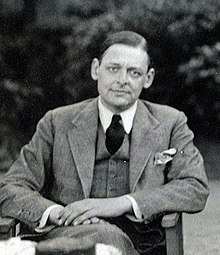
Thomas Stearns Eliot OM (26 September 1888 – 4 January 1965) was an essayist, publisher, playwright, literary and social critic, and "one of the twentieth century's major poets."[1] He was born in St. Louis, Missouri to an old Yankee family. However he emigrated to England in 1914 (at age 25) and was naturalised as a British subject in 1927 at age 39, renouncing his American citizenship.[2]
Eliot attracted widespread attention for his poem The Love Song of J. Alfred Prufrock (1915), which is seen as a masterpiece of theModernist movement. It was followed by some of the best-known poems in the English language, including The Waste Land (1922),The Hollow Men (1925), Ash Wednesday (1930) and Four Quartets (1945).[3] He is also known for his seven plays, particularlyMurder in the Cathedral (1935). He was awarded the Nobel Prize in Literature in 1948, "for his outstanding, pioneer contribution to present-day poetry."
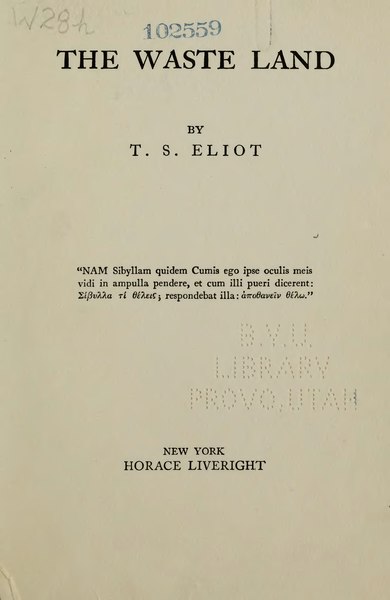
*The Waste Land
→"The Waste Land", by T.S. Eliot, is widely regarded as "one of the most important poems of the 20th century" and a central text inModernist poetry.[1][2] Published in 1922, the 434-line[B] poem first appeared in the United Kingdom in the October issue of The Criterion and in the United States in the November issue of The Dial. It was published in book form in December 1922. Among its famous phrases are "April is the cruellest month", "I will show you fear in a handful of dust", and the mantra in the Sanskrit language "Shantih shantih shantih".
→The poem's structure is divided into five sections. The first section, The Burial of the Dead introduces the diverse themes of disillusionment and despair. The second, A Game of Chess employs vignettes of several characters—alternating narrations—that address those themes experientially. The Fire Sermon, the third section, offers a philosophical meditation in relation to the imagery of death and views of self-denial in juxtaposition influenced by Augustine of Hippo and eastern religions. After a fourth section that includes a brief lyrical petition, the culminating fifth section, What the Thunder Said concludes with an image of judgment.
--------------------------------------
3) Modernism (後浪漫主義)

Modernism is a philosophical movement that, along with cultural trends and changes, arose from wide-scale and far-reaching transformations in Western society in the late 19th and early 20th centuries. Among the factors that shaped Modernism were the development of modern industrial societies and the rapid growth of cities, followed then by the horror of World War I. Modernism also rejected the certainty of Enlightenment thinking, and many modernists rejected religious belief.
---------------------------------------
4) imagism
Imagism was a movement in early 20th-century Anglo-American poetry that favored precision of imagery and clear, sharp language. It has been described as the most influential movement in English poetry since the activity of the Pre-Raphaelites.[1] As a poetic style it gave Modernism its start in the early 20th century,[2] and is considered to be the first organized Modernist literary movement in the English language.[3] Imagism is sometimes viewed as 'a succession of creative moments' rather than any continuous or sustained period of development.[4] René Taupin remarked that 'It is more accurate to consider Imagism not as a doctrine, nor even as a poetic school, but as the association of a few poets who were for a certain time in agreement on a small number of important principles'.
------------------------------------------
Arianne Moore (November 15, 1887 – February 5, 1972) was an American Modernist poet and writer noted for her irony and wit.
poetry
I, too, dislike it: there are things that are important beyond all this fiddle.
Reading it, however, with a perfect contempt for it, one discovers in
it after all, a place for the genuine.
Hands that can grasp, eyes
that can dilate, hair that can rise
if it must, these things are important not because a
high-sounding interpretation can be put upon them but because they are
useful. When they become so derivative as to become unintelligible,
the same thing may be said for all of us, that we
do not admire what
we cannot understand: the bat
holding on upside down or in quest of something to
eat, elephants pushing, a wild horse taking a roll, a tireless wolf under
a tree, the immovable critic twitching his skin like a horse that feels a flea, the base-
ball fan, the statistician—
nor is it valid
to discriminate against "business documents and
school-book"; all these phenomena are important. One must make a distinction
however: when dragged into prominence by half poets, the result is not poetry,
nor till the poets among us can be
"literalists of
the imagination"—above
insolence and triviality and can present
for inspection, "imaginary gardens with real toads in them," shall we have
it. In the meantime, if you demand on the one hand,
the raw material of poetry in
all its rawness and
that which is on the other hand
genuine, you are interested in poetry.
------------------------------
6) New Year's Eve

New Year's Eve is a 2011 romantic comedy film directed by Garry Marshall.[5] Like Valentine's Day, Marshall's previous film, it depicts a series of holiday vignettes of the state of several romances and features a large ensemble cast led by Halle Berry, Jessica Biel, Jon Bon Jovi, Abigail Breslin, Chris "Ludacris" Bridges, Robert De Niro, Josh Duhamel, Zac Efron, Héctor Elizondo, Katherine Heigl, Ashton Kutcher, Seth Meyers, Lea Michele, Sarah Jessica Parker, Michelle Pfeiffer, Til Schweiger, Hilary Swank, Sofía Vergara.
-------------------------------------
7) E.E. Commings

7) E.E. Commings
Edward Estlin Cummings (October 14, 1894 – September 3, 1962), known as E. E. Cummings, with the abbreviated form of his name often written by others in lowercase letters as e e cummings (in the style of some of his poems—see name and capitalization, below), was an American poet, painter, essayist, author, and playwright. His body of work encompasses approximately 2,900 poems, two autobiographical novels, four plays and several essays, as well as numerous drawings and paintings. He is remembered as an eminent voice of 20th century English literature.
*Buffalo Bill's
Buffalo Bill 's
defunct
who used to
ride a watersmooth-silver
stallion
and break onetwothreefourfive pigeonsjustlikethat
Jesus
he was a handsome man
and what i want to know is
how do you like your blueeyed boy
Mister Death
* In just
in Just-
spring when the world is mud-
luscious the little
lame balloonman
whistles far and wee
and eddieandbill come
running from marbles and
piracies and it's
spring
when the world is puddle-wonderful
the queer
old balloonman whistles
far and wee
and bettyandisbel come dancing
from hop-scotch and jump-rope and
it's
spring
and
the
goat-footed
balloonMan whistles
far
and
wee
somewhere i have never travelled, gladly beyond
any experience,your eyes have their silence:
in your most frail gesture are things which enclose me,
or which i cannot touch because they are too near
your slightest look easily will unclose me
though i have closed myself as fingers,
you open always petal by petal myself as Spring opens
(touching skilfully,mysteriously)her first rose
or if your wish be to close me, i and
my life will shut very beautifully ,suddenly,
as when the heart of this flower imagines
the snow carefully everywhere descending;
nothing which we are to perceive in this world equals
the power of your intense fragility:whose texture
compels me with the color of its countries,
rendering death and forever with each breathing
(i do not know what it is about you that closes
and opens;only something in me understands
the voice of your eyes is deeper than all roses)
nobody,not even the rain,has such small hands
* you open always petal by petal myself as Spring opens←→
"She blossomed for him." (from Great Gatsby)
------------------------------------------
The generational gap is a term popularized in Western countries during the 1960s referring to differences between people of younger generations and their elders, especially between children and their parents. Examples of these differences include language, appearance, or technology.[1]
Although some generational differences have existed throughout history, modern generational gaps have often been attributed to rapid cultural change in the modern and postmodern period, particularly with respect to such matters as musical tastes, fashion, technology and politics. These changes are assumed to have been magnified by the unprecedented size of the young generation during the 1960s, which gave it the power and inclination to rebel against societal norms.
Generation X, commonly abbreviated to Gen X, is the generation born after the Western Post–World War II baby boom. Demographers, historians, and commentators use beginning birth dates ranging from the early 1960s to the early 1980s.
-------------------------------------------
9) Tennessee William
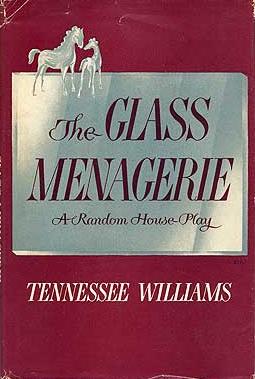
Thomas Lanier "Tennessee" Williams III (March 26, 1911 – February 25, 1983) was an American playwright and author of many stage classics.
After years of obscurity, he became suddenly famous with The Glass Menagerie (1944), closely reflecting his own unhappy family background. This heralded a string of successes, including A Streetcar Named Desire, Cat on a Hot Tin Roof, Orpheus Descending, and Sweet Bird of Youth. His later work attempted a new style that did not appeal to audiences, and alcohol and drug dependence further inhibited his creative output.
Williams adapted much of his best work for the cinema, and also wrote short stories, poetry, essays and a volume of memoirs. In 1979, four years before his death, he was inducted into the American Theater Hall of Fame.
* The Glass Menagerie

→ The play has strong autobiographical elements, featuring characters based on Williams himself, his histrionic mother, and his mentally fragile sister Laura. In writing the play, Williams drew on an earlier short story, as well as a screenplay he had written under the title of The Gentleman Caller.
→The characters and story mimic Williams's own life more closely than any of his other works. Williams (whose real name was Thomas) would be Tom, his mother, Amanda. His sickly and mentally unstable older sister Rose provides the basis for the fragile Laura (whose nickname in the play is "Blue Roses", a result of a bout of pleurosis as a high school student), though it has also been suggested that Laura may incorporate aspects of Williams himself, referencing his introverted nature and obsessive focus on a part of life (writing for Williams and glass animals in Laura's case).
*A Streetcar Named Desire (The Poker Night)
A Streetcar Named Desire is a 1947 play written by American playwright Tennessee Williams[1] for which he received the Pulitzer Prize for Drama in 1948. The play opened on Broadway on December 3, 1947, and closed on December 17, 1949, in the Ethel Barrymore Theatre. The Broadway production was directed by Elia Kazan and starred Marlon Brando, Jessica Tandy, Kim Hunter, and Karl Malden.[2] The London production opened in 1949 with Bonar Colleano, Vivien Leigh, and Renee Asherson and was directed by Laurence Olivier.
I don’t want realism. I want magic! [Mitch laughs] Yes, yes, magic! I try to give that to people. I misrepresent things to them. I don’t tell the truth, I tell what ought to be truth. And if that is sinful, then let me be damned for it! – Don’t turn the light on! (9.43)
→Now we see that Blanche’s fear of the strong light is about more than the age showing on her face. She’s not only hiding her appearances from the world, but refusing to look at the world in a harsh light herself.
*Stanley Kowalski
Stanley lives in the working class Faubourg Marigny neighborhood of New Orleans with his wife, Stella (née Dubois), and is employed as a factory parts salesman. He was an Army engineer in World War II, having served as a Master Sergeant. He has a vicious temper, and fights often with his wife, leading to instances of domestic violence. Near the beginning of the play, Stanley announces that Stella is pregnant.
--------------------------------------------
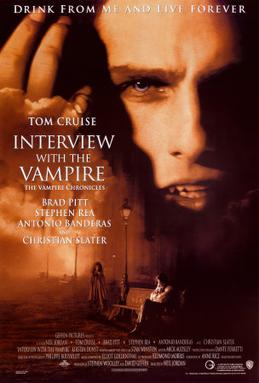
10) Interview with the Vampire
Interview with the Vampire: The Vampire Chronicles is a 1994 American romantic horror film directed by Neil Jordan, based on the 1976 novel Interview with the Vampire by Anne Rice, and starring Tom Cruise and Brad Pitt. The film focuses on Lestat (Cruise) and Louis (Pitt), beginning with Louis' transformation into a vampire by Lestat in 1791. The film chronicles their time together, and their turning of a twelve-year-old girl, Claudia, into a vampire. The narrative is framed by a present day interview, in which Louis tells his story to a San Francisco reporter. The supporting cast features Christian Slater, Kirsten Dunst and Antonio Banderas.
-----------------------------------------------
11) Over the Hedge (film)
森林保衛戰

Over the Hedge is a 2006 American computer-animated comedy film based on the characters from the United Media comic strip of the same name. Directed by Tim Johnson and Karey Kirkpatrick, and produced by Bonnie Arnold, it was released in the United States on May 19, 2006.
---------------------------------------------
12) I wish I was in Dixie Land (song)
"Dixie", also known as "I Wish I Was in Dixie", "Dixie's Land", and other titles, is a popular American song. It is one of the most distinctively American musical products of the 19th century,[1] and probably the best-known song to have come out of blackfaceminstrelsy.[2] Although not a folk song at its creation, "Dixie" has since entered the American folk vernacular. The song likely cemented the word "Dixie" in the American vocabulary as a toponym for the Southern United States.
---------------------------------------------
Word:
1) hop-scotch: 跳格子
訂閱:
文章 (Atom)