1) time line (literature period)
tragedy courtly love
comedy 3M
epic 1) morality play
2) mystery play
3) miracle play
classicism → medieval → renaissance → neoclassicism
(reason) (faith) (reason) (faith)
→ romanticism → victorianism → modernism
(reason) (faith) (reason)
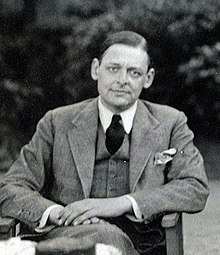
Thomas Stearns Eliot OM (26 September 1888 – 4 January 1965) was an essayist, publisher, playwright, literary and social critic, and "one of the twentieth century's major poets."[1] He was born in St. Louis, Missouri to an old Yankee family. However he emigrated to England in 1914 (at age 25) and was naturalised as a British subject in 1927 at age 39, renouncing his American citizenship.[2]
Eliot attracted widespread attention for his poem The Love Song of J. Alfred Prufrock (1915), which is seen as a masterpiece of theModernist movement. It was followed by some of the best-known poems in the English language, including The Waste Land (1922),The Hollow Men (1925), Ash Wednesday (1930) and Four Quartets (1945).[3] He is also known for his seven plays, particularlyMurder in the Cathedral (1935). He was awarded the Nobel Prize in Literature in 1948, "for his outstanding, pioneer contribution to present-day poetry."
*The Waste Land
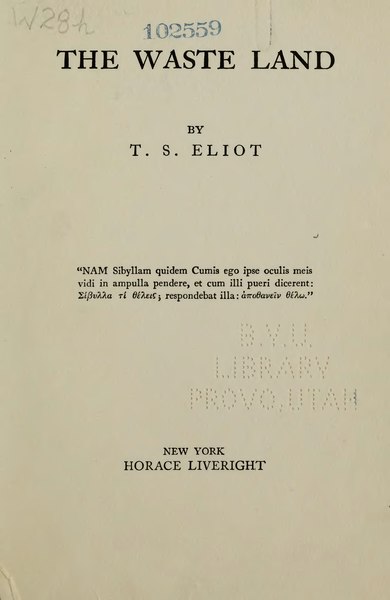
→"The Waste Land", by T.S. Eliot, is widely regarded as "one of the most important poems of the 20th century" and a central text inModernist poetry.[1][2] Published in 1922, the 434-line[B] poem first appeared in the United Kingdom in the October issue of The Criterion and in the United States in the November issue of The Dial. It was published in book form in December 1922. Among its famous phrases are "April is the cruellest month", "I will show you fear in a handful of dust", and the mantra in the Sanskrit language "Shantih shantih shantih".
→The poem's structure is divided into five sections. The first section, The Burial of the Dead introduces the diverse themes of disillusionment and despair. The second, A Game of Chess employs vignettes of several characters—alternating narrations—that address those themes experientially. The Fire Sermon, the third section, offers a philosophical meditation in relation to the imagery of death and views of self-denial in juxtaposition influenced by Augustine of Hippo and eastern religions. After a fourth section that includes a brief lyrical petition, the culminating fifth section, What the Thunder Said concludes with an image of judgment.
--------------------------------------
3) Modernism (後浪漫主義)

Modernism is a philosophical movement that, along with cultural trends and changes, arose from wide-scale and far-reaching transformations in Western society in the late 19th and early 20th centuries. Among the factors that shaped Modernism were the development of modern industrial societies and the rapid growth of cities, followed then by the horror of World War I. Modernism also rejected the certainty of Enlightenment thinking, and many modernists rejected religious belief.
---------------------------------------
4) imagism
Imagism was a movement in early 20th-century Anglo-American poetry that favored precision of imagery and clear, sharp language. It has been described as the most influential movement in English poetry since the activity of the Pre-Raphaelites.[1] As a poetic style it gave Modernism its start in the early 20th century,[2] and is considered to be the first organized Modernist literary movement in the English language.[3] Imagism is sometimes viewed as 'a succession of creative moments' rather than any continuous or sustained period of development.[4] René Taupin remarked that 'It is more accurate to consider Imagism not as a doctrine, nor even as a poetic school, but as the association of a few poets who were for a certain time in agreement on a small number of important principles'.
------------------------------------------

Arianne Moore (November 15, 1887 – February 5, 1972) was an American Modernist poet and writer noted for her irony and wit.
poetry
I, too, dislike it: there are things that are important beyond all this fiddle.
Reading it, however, with a perfect contempt for it, one discovers in
it after all, a place for the genuine.
Hands that can grasp, eyes
that can dilate, hair that can rise
if it must, these things are important not because a
high-sounding interpretation can be put upon them but because they are
useful. When they become so derivative as to become unintelligible,
the same thing may be said for all of us, that we
do not admire what
we cannot understand: the bat
holding on upside down or in quest of something to
eat, elephants pushing, a wild horse taking a roll, a tireless wolf under
a tree, the immovable critic twitching his skin like a horse that feels a flea, the base-
ball fan, the statistician—
nor is it valid
to discriminate against "business documents and
school-book"; all these phenomena are important. One must make a distinction
however: when dragged into prominence by half poets, the result is not poetry,
nor till the poets among us can be
"literalists of
the imagination"—above
insolence and triviality and can present
for inspection, "imaginary gardens with real toads in them," shall we have
it. In the meantime, if you demand on the one hand,
the raw material of poetry in
all its rawness and
that which is on the other hand
genuine, you are interested in poetry.
------------------------------
6) New Year's Eve

New Year's Eve is a 2011 romantic comedy film directed by Garry Marshall.[5] Like Valentine's Day, Marshall's previous film, it depicts a series of holiday vignettes of the state of several romances and features a large ensemble cast led by Halle Berry, Jessica Biel, Jon Bon Jovi, Abigail Breslin, Chris "Ludacris" Bridges, Robert De Niro, Josh Duhamel, Zac Efron, Héctor Elizondo, Katherine Heigl, Ashton Kutcher, Seth Meyers, Lea Michele, Sarah Jessica Parker, Michelle Pfeiffer, Til Schweiger, Hilary Swank, Sofía Vergara.
Reading it, however, with a perfect contempt for it, one discovers in
it after all, a place for the genuine.
Hands that can grasp, eyes
that can dilate, hair that can rise
if it must, these things are important not because a
high-sounding interpretation can be put upon them but because they are
useful. When they become so derivative as to become unintelligible,
the same thing may be said for all of us, that we
do not admire what
we cannot understand: the bat
holding on upside down or in quest of something to
eat, elephants pushing, a wild horse taking a roll, a tireless wolf under
a tree, the immovable critic twitching his skin like a horse that feels a flea, the base-
ball fan, the statistician—
nor is it valid
to discriminate against "business documents and
school-book"; all these phenomena are important. One must make a distinction
however: when dragged into prominence by half poets, the result is not poetry,
nor till the poets among us can be
"literalists of
the imagination"—above
insolence and triviality and can present
for inspection, "imaginary gardens with real toads in them," shall we have
it. In the meantime, if you demand on the one hand,
the raw material of poetry in
all its rawness and
that which is on the other hand
genuine, you are interested in poetry.
------------------------------
6) New Year's Eve
New Year's Eve is a 2011 romantic comedy film directed by Garry Marshall.[5] Like Valentine's Day, Marshall's previous film, it depicts a series of holiday vignettes of the state of several romances and features a large ensemble cast led by Halle Berry, Jessica Biel, Jon Bon Jovi, Abigail Breslin, Chris "Ludacris" Bridges, Robert De Niro, Josh Duhamel, Zac Efron, Héctor Elizondo, Katherine Heigl, Ashton Kutcher, Seth Meyers, Lea Michele, Sarah Jessica Parker, Michelle Pfeiffer, Til Schweiger, Hilary Swank, Sofía Vergara.
-------------------------------------
7) E.E. Commings

7) E.E. Commings





沒有留言:
張貼留言