1) Emily Dickinson
→ two poems
* Because I could not stop for Death
"Because I could not stop for Death" is a lyrical poem by Emily Dickinson first published posthumously in Poems: Series 1 in 1890. The poem is about Death. Dickinson personifies him (death) as a gentleman caller who takes a leisurely carriage ride with the poet to her grave. According to Thomas H. Johnson's variorum edition of 1955 the number of this poem is 712.
*A narrow fellow in the grass
A narrow fellow in the grass
Occasionally rides;
You may have met him—did you not
His notice sudden is,
The grass divides as with a comb,
A spotted shaft is seen,
And then it closes at your feet,
And opens further on.
He likes a boggy acre,
A floor too cool for corn,
But when a boy and barefoot,
I more than once at noon
Have passed, I thought, a whip lash,
Unbraiding in the sun,
When stooping to secure it,
It wrinkled and was gone.
Several of nature’s people
I know, and they know me;
I feel for them a transport
Of cordiality.
But never met this fellow,
Attended or alone,
Without a tighter breathing,
And zero at the bone.
-------------------------------------------
2) Romanticism (transcendentalism 的後續)
Romanticism (also the Romantic era or the Romantic period) was an artistic, literary, and intellectual movement that originated in Europe toward the end of the 18th century and in most areas was at its peak in the approximate period from 1800 to 1850. Partly a reaction to the Industrial Revolution,[1] it was also a revolt against the aristocratic social and political norms of the Age of Enlightenment and a reaction against the scientific rationalization of nature.
*key word: splendid
-----------------------------------------------
3) Splendor in the Grass (film)
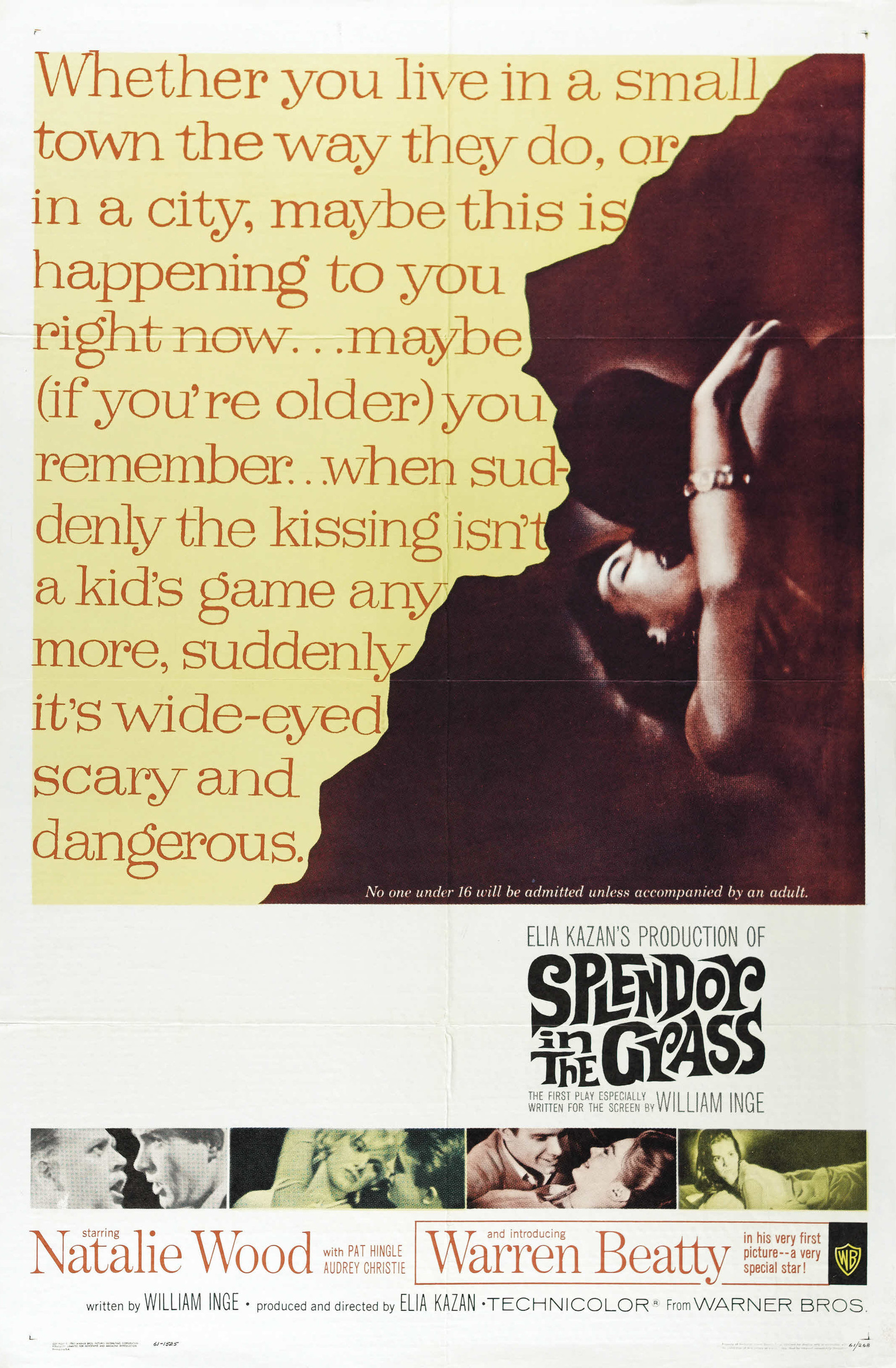
Splendor in the Grass is a 1961 Technicolor romantic drama film that tells a story of sexual repression, love, and heartbreak, from which the character Deanie suffers. Written by William Inge, who appears briefly as a Protestant clergyman and won an Oscar for his screenplay, the film was directed by Elia Kazan.
*character
- Natalie Wood as Wilma Dean "Deanie" Loomis
- Warren Beatty as Bud Stamper
*The film is based on the poem, Ode. Intimations of Immortality from Recollections of Early Childhood, from William Wordsworth.
“Though nothing can bring back the hour
Of splendor in the grass, of glory in the flower;
We will grieve not, rather find
Strength in what remains behind;
In the primal sympathy
Which having been must ever be...”
→逝者已矣,來者可追;感時花濺淚,恨別鳥驚心
---------------------------------------------
4) Walt Whitman
* nation poet of Democracy
poem
*The Leaves of Grass
The poems of Leaves of Grass are loosely connected and each represents Whitman's celebration of his philosophy of life and humanity. This book is notable for its discussion of delight in sensual pleasures during a time when such candid displays were considered immoral. Where much previous poetry, especially English, relied on symbolism, allegory, and meditation on the religious and spiritual, Leaves of Grass (particularly the first edition) exalted the body and the material world. Influenced by Ralph Waldo Emerson and the Transcendentalist movement, itself an offshoot of Romanticism, Whitman's poetry praises nature and the individual human's role in it. However, much like Emerson, Whitman does not diminish the role of the mind or the spirit; rather, he elevates the human form and the human mind, deeming both worthy of poetic praise.
* "O Captain! My Captain!"

"O Captain! My Captain!" is an extended metaphor poem written in 1865 by Walt Whitman, about the death of American president Abraham Lincoln. The poem was first published in the pamphlet Sequel to Drum-Taps which assembled 18 poems regarding the American Civil War, including another Lincoln elegy, When Lilacs Last in the Dooryard Bloom'd. It was included in Whitman's comprehensive collection Leaves of Grass beginning with its fourth edition published in 1867.
*elegy (輓歌)
→ melancholic poem ( "You 've fallen cold and dead.")
*Dark Horse: Lincoln
--------------------------------------------------
5) free verse (白話詩)
Free verse is an open form (see Poetry analysis) of poetry. It does not use consistent meter patterns, rhyme, or any other musical pattern. It thus tends to follow the rhythm of natural speech
*Although free verse requires no meter, rhyme, or other traditional poetic techniques, a poet can still use them to create some sense of structure. A clear example of this can be found in Walt Whitman's poems, where he repeats certain phrases and uses commas to create both a rhythm and structure. Much pattern and discipline is to be found in free verse: the internal pattern of sounds, the choice of exact words, and the effect of associations give free verse its beauty.
6) blank verse
lank verse is poetry written in regular metrical but unrhymed lines, almost always iambic pentameters.[1] It has been described as "probably the most common and influential form that English poetry has taken since the 16th century"[2] and Paul Fussell has estimated that "about three-quarters of all English poetry is in blank verse."
*Heroic couplet (兩句一組一尾韻)
---------------------------------------------
7) imagism ('象徵主義)
Imagism was a movement in early 20th-century Anglo-American poetry that favored precision of imagery and clear, sharp language. It has been described as the most influential movement in English poetry since the activity of the Pre-Raphaelites.[1] As a poetic style it gave Modernism its start in the early 20th century,[2] and is considered to be the first organized Modernist literary movement in the English language.[3] Imagism is sometimes viewed as 'a succession of creative moments' rather than any continuous or sustained period of development.
--------------------------------------------
8)Funeral Blues
"Funeral Blues" or "Stop all the clocks" is a poem by W. H. Auden. An early version was published in 1936, but the poem in its final, familiar form was first published in The Year's Poetry (London, 1938).
*Four Weddings and a Funeral - "Funeral Blues"
→" I thought that love would last forever: I was wrong!"
He was my North, my South, my East and West,
My working week and my Sunday rest,
My noon, my midnight, my talk, my song;
I thought that love would last for ever: I was wrong.
My working week and my Sunday rest,
My noon, my midnight, my talk, my song;
I thought that love would last for ever: I was wrong.
The stars are not wanted now: put out every one;
Pack up the moon and dismantle the sun;
Pour away the ocean and sweep up the wood.
For nothing now can ever come to any good.
------------------------------------------------------Pack up the moon and dismantle the sun;
Pour away the ocean and sweep up the wood.
For nothing now can ever come to any good.
9)The Waste Land
"The Waste Land", by T.S. Eliot, is widely regarded as "one of the most important poems of the 20th century" and a central text in Modernist poetry.
* "APRIL is the cruellest month, breeding..."
" Winter kept us warm."
-------------------------------------------------------
10)When Lilacs Last in the Dooryard Bloom'd

When Lilacs Last in the Dooryard Bloom'd is a long poem in the form of an elegy written by American poet Walt Whitman (1819–1892) in 1865. It is a 206-line poem written in free verse and employing many of the devices and conceits of the pastoral elegy. The poem was written in the Summer of 1865 during a period of profound national mourning in the aftermath of the assassination of President Abraham Lincoln on 14 April 1865. Despite the poem being an elegy to the fallen president, Whitman neither mentions Lincoln by name nor discusses the circumstances of his death. Instead, Whitman uses a series of rural and natural imagery including the symbols of the lilacs, a drooping star in the western sky (Venus), and the hermit thrush, and employs the traditional progression of the pastoral elegy in moving from grief toward an acceptance and knowledge of death. The poem also addresses the pity of war through imagery vaguely referencing the American Civil War (1861–1865) which ended only days before the assassination.
* apostrophe
O powerful, western, fallen star!
O shades of night! O moody, tearful night!
O great star disappear’d! O the black murk that hides the star!(lines 7-9)
----------------------------------------------------
Word:
1) index: 指數
*index finger: 大拇指
2) cap-: head
*capital
*captain
*capitalism (砍頭)


沒有留言:
張貼留言