
1). Let it snow (song)
Let it Snow
Oh the weather outside is frightful
But the fire is so delightful
And since we've no place to go
Let It Snow! Let It Snow! Let It Snow!
It doesn't show signs of stopping
And I've bought some corn for popping
The lights are turned way down low
Let It Snow! Let It Snow! Let It Snow!
When we finally kiss good night
How I'll hate going out in the storm!
But if you'll really hold me tight
All the way home I'll be warm
The fire is slowly dying
And, my dear, we're still goodbying
But as long as you love me so
Let It Snow! Let It Snow! Let It Snow!
--------------------------
2)
“The realism practiced by Edith Wharton and Henry James focused on the interior moral and psychological lives of upper-class people. . . . Wharton and James hoped to convince readers—most of whom were from the middle class—that the inner lives of the privileged were in accord with the truths of human nature. Wealthy people had what working people did not—time to develop and display their inner selves; they were just like everybody else, although more so.”
“The realism practiced by Edith Wharton and Henry James focused on the interior moral and psychological lives of upper-class people. . . . Wharton and James hoped to convince readers—most of whom were from the middle class—that the inner lives of the privileged were in accord with the truths of human nature. Wealthy people had what working people did not—time to develop and display their inner selves; they were just like everybody else, although more so.”
- Edith Wharton

Edith Wharton (January 24, 1862 – August 11, 1937) was a Pulitzer Prize-winningAmerican novelist, short story writer, and designer. She was nominated for the Nobel Prize in Literature in 1927, 1928 and 1930.[1]Wharton combined her insider's view of America's privileged classes with a brilliant, natural wit to write humorous, incisive novels and short stories of social and psychological insight. She was well acquainted with many of her era's other literary and public figures, including Theodore Roosevelt.
*The Age of Innocence
純真年代
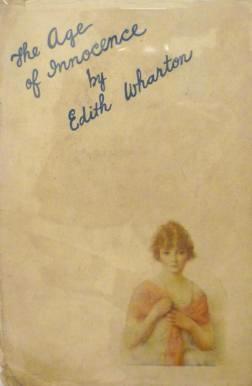
The Age of Innocence is Edith Wharton's twelfth novel, initially serialized in four parts in the Pictorial Review magazine in 1920, and later released by D. Appleton and Company as a book in New York and in London. It won the 1921 Pulitzer Prize for Fiction, making it the first novel written by a woman to win the Pulitzer Prize for Fiction, and thus Wharton the first woman to win the prize.[1]The story is set in upper-class New York City in the 1870s.
- Henry James

Henry James, OM (15 April 1843 – 28 February 1916) was an American writer who spent most of his writing career in Britain. He is regarded as one of the key figures of 19th-century literary realism. He was the son of Henry James, Sr. and the brother of philosopher and psychologist William James and diarist Alice James.
------------------------------------------
→國際主題(跨大西洋主題)
* free will (Adam & Eve)----------------------------------------
4)
“Literary naturalists, unlike the realists for whom human beings defined themselves within recognizable settings, wrote about human life as it was shaped by forces beyond human control. For them, their view was truly realistic. . . . Naturalists wanted to explore how biology, environment, and other material forces shaped lives—particularly the lives of lower-class people, who supposedly had less control over their lives than those who were better off.”
*Many noted authors of the late nineteenth century began their careers as
a) university professors. b) religious clergy. c) visual artists. d)
newspaper journalists.
*Which of the following best describes the conditions most urban factory workers faced at the end of the nineteenth century?
a) low wages, dangerous working conditions, and few laws regulating safety
or working hours
---------------------------------------------
5) Whit Waltman/ Emily Dickinson
→free verse
*free verse
Free verse is an open form (see Poetry analysis) of poetry. It does not use consistent meter patterns, rhyme, or any other musical pattern. It thus tends to follow the rhythm of natural speech.
----------------------------------------------------------
6) Modernist poetry
- “Stopping by Woods on a Snowy Evening”
Whose woods these are I think I know.
His house is in the village, though;
He will not see me stopping here
To watch his woods fill up with snow.
My little horse must think it queer 5
To stop without a farmhouse near
Between the woods and frozen lake
The darkest evening of the year.
He gives his harness bells a shake
To ask if there is some mistake. 10
The only other sounds the sweep
Of easy wind and downy flake.
The woods are lovely, dark, and deep,
But I have promises to keep,
And miles to go before I sleep, 15
And miles to go before I sleep.

- The road not taken
Two roads diverged in a yellow wood,
And sorry I could not travel both
And be one traveler, long I stood
And looked down one as far as I could
To where it bent in the undergrowth;

Then took the other, as just as fair,
And having perhaps the better claim,
Because it was grassy and wanted wear;
Though as for that the passing there
Had worn them really about the same,

And both that morning equally lay
In leaves no step had trodden black.
Oh, I kept the first for another day!
Yet knowing how way leads on to way,
I doubted if I should ever come back.

I shall be telling this with a sigh
Somewhere ages and ages hence:
Two roads diverged in a wood, and I--
I took the one less traveled by,
And that has made all the difference.

--------------------------------
7) 夢 (film) --- 黑澤明

《夢》乃日本知名導演黑澤明在1990年執導的電影,該片由八則夢境片段組成,曾入圍1990年坎城影展。
*(春、夏、秋、冬)
第一段:太陽雨
第二段:桃園
第三段:暴風雪
第四段:隧道
第五段:鴉
第六段:紅色富士山
第七段:鬼泣
第八段:水車村
---------------------------------------------
7) fragmentation
Fragmentation is another important aspect of postmodern literature. Various elements, concerning plot, characters, themes, imagery and factual references are fragmented and dispersed throughout the entire work. In general, there is an interrupted sequence of events, character development and action which can at first glance look modern. Fragmentation purports, however, to depict a metaphysically unfounded, chaotic universe. It can occur in language, sentence structure or grammar.
---------------------------------------------
8) Anecdote of the Jar
-----------------------------------------
9) Journey of the Magi

"Journey of the Magi" is a 43-line poem written in 1927 by T. S. Eliot (1888–1965). It is one of five poems that Eliot contributed for a series of 38 pamphlets by several authors collectively titled Ariel poems and released by British publishing house Faber and Gwyer (later, Faber and Faber). Published in August 1927, "Journey of the Magi" was the eighth in the series and was accompanied by illustrations drawn by American-born avant garde artist Edward McKnight Kauffer (1890–1954).[1] The poems, including "Journey of the Magi", were later published in both editions of Eliot's collected poems in 1936 and 1963.
*信仰的破產/對信仰的質疑
*empty wine- skins (神蹟)
*Were we lead all that way for birth or death?
------------------------------------------------
7) fragmentation
Fragmentation is another important aspect of postmodern literature. Various elements, concerning plot, characters, themes, imagery and factual references are fragmented and dispersed throughout the entire work. In general, there is an interrupted sequence of events, character development and action which can at first glance look modern. Fragmentation purports, however, to depict a metaphysically unfounded, chaotic universe. It can occur in language, sentence structure or grammar.
---------------------------------------------
8) Anecdote of the Jar
Anecdote of the Jar
I placed a jar in Tennessee,
And round it was, upon a hill.
It made the slovenly wilderness
Surround that hill.
The wilderness rose up to it,
And sprawled around, no longer wild.
The jar was round upon the ground
And tall and of a port in air.
It took dominion everywhere.
The jar was gray and bare.
It did not give of bird or bush,
Like nothing else in Tennessee.
*anecdote:軼事
*dominion: 領地
9) Journey of the Magi
"Journey of the Magi" is a 43-line poem written in 1927 by T. S. Eliot (1888–1965). It is one of five poems that Eliot contributed for a series of 38 pamphlets by several authors collectively titled Ariel poems and released by British publishing house Faber and Gwyer (later, Faber and Faber). Published in August 1927, "Journey of the Magi" was the eighth in the series and was accompanied by illustrations drawn by American-born avant garde artist Edward McKnight Kauffer (1890–1954).[1] The poems, including "Journey of the Magi", were later published in both editions of Eliot's collected poems in 1936 and 1963.
*信仰的破產/對信仰的質疑
*empty wine- skins (神蹟)
*Were we lead all that way for birth or death?
------------------------------------------------
Word:
1) wage: 時薪
e.g., segregate/ seperate
3) amend- : adjust
e.g., amendment 憲法增修條文
4) psychiatrist :精神病醫生
5) -ant (什麼人、甚麼專業人員)
e.g., accountant, immigrant(移出者), migrant (移入者)

沒有留言:
張貼留言