Hypothesis
↓
supportive idea (retell the story from the plot)
*Q:Does the title, "Finding Forrester," refer more to Forrester’s helping Jamal become a better writer or to Jamal’s helping Forrester find him-self?
A:As Finding Forrester, the main idea is that the two, Forrester and Jamal, learn from each other, which means they all find their own identity at the end.
* Q:Why does Forrester credit Jamal’s coming into his life for realizing his dream so late in life?
→ realize the dream= carry the dream out = 實現夢想
-------------------
2.some principles in essay writing
* Don't show the personal philosophical debate from nowhere.
*Put the supportive proof from the plot.
* Don't use " I think".
*Don't use "first... second... third.
*Put your supportive proof from the plot in the body paragraphs.
--------------------
3. Araby
"Araby" is a short story by James Joyce published in his 1914 collection Dubliners.
*plot overview
A young boy falls in love with his neighbor Mangan’s sister. He spends his time watching her from his house or thinking about her. He and the girl finally talk, and she suggests that he visit a bazaar called Araby, which she cannot attend. The boy plans to go and purchase something for the girl, but he arrives late and buys nothing.
*"Araby" touches on a great number of themes:
- coming of age
- the loss of innocence
- the life of the mind versus poverty (both physical and intellectual)
- the consequences of idealization
- the Catholic Church's influence to make Dublin a place of asceticism where desire and sensuality are seen as immoral[2]
- the pain that often comes when one encounters love in reality instead of its elevated form
- paralysis
These themes build on one another entirely through the thoughts of the young boy, who is portrayed by the first-person narrator, who writes from memory.
*some excerpts:
- She was waiting for us, her figure defined by the light from the half-opened door. Her brother always teased her before he obeyed, and I stood by the railings looking at her. Her dress swung as she moved her body, and the soft rope of her hair tossed from side to side…
- While she spoke she turned a silver bracelet round and round her wrist. She could not go, she said, because there would be a retreat that week in her convent. Her brother and two other boys were fighting for their caps, and I was alone at the railings. She held one of the spikes, bowing her head towards me. The light from the lamp opposite our door caught the white curve of her neck, lit up her hair that rested there and, falling, lit up the hand upon the railing. It fell over one side of her dress and caught the white border of a petticoat, just visible as she stood at ease.
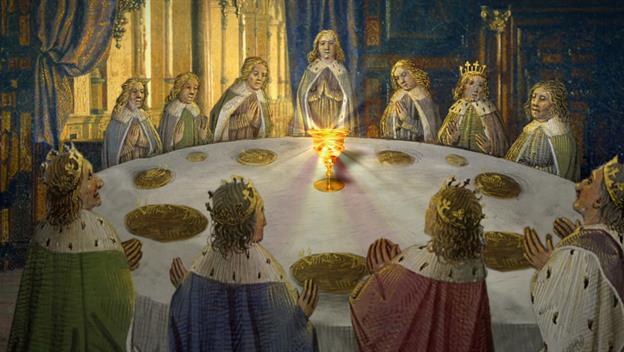
4. chalice= the Holy Grail= a great mission
*The Holy Grail is a dish, plate, stone, or cup that is part of an important theme of Arthurian literature. A grail, wondrous but not explicitly holy, first appears in Perceval le Gallois, an unfinished romance by Chrétien de Troyes:[1] it is a processional salver used to serve at a feast. Chrétien's story attracted many continuators, translators and interpreters in the later 12th and early 13th centuries, includingWolfram von Eschenbach, who makes the grail a great precious stone that fell from the sky. The Grail legend became interwoven with legends of the Holy Chalice.
--------------------
5. in Araby
" hand as shilling to a weary-looking man..."
*symbol& meaning
→ initiation journey
→a journey of no return
→this image foreshadowing Charon, ferryman by the River Styx
-------------------
6. in Araby
I listened to the fall of the coins. Remembering with difficulty
why I had come, I went over to one of the stalls and examined porcelain vases
and flowered tea-sets. At the door of the stall a young lady was talking and
laughing with two young gentlemen. I remarked their English accents and
listened vaguely to their conversation.
'O, I never said such a thing!'
'O, but you did!'
'O, but I didn't!'
'Didn't she say that?'
'Yes. I heard her.'
'O, there's a... fib!'
…Gazing up into the darkness I saw myself as a creature driven and
derided by vanity; and my eyes burned with anguish and anger.
→The boy came to a sudden understanding of what he has gone through is
sometimes called epiphany.
*An epiphany is an experience of sudden and striking realization. Generally the term is used to describe scientific breakthrough, religious or philosophical discoveries, but it can apply in any situation in which an enlightening realization allows a problem or situation to be understood from a new and deeper perspective.
------------------------
7. James Joyce

James Augustine Aloysius Joyce (2 February 1882 – 13 January 1941) was an Irish novelist and poet, considered to be one of the most influential writers in the modernist avant-garde of the early 20th century. Joyce is best known for Ulysses (1922), a landmark work in which the episodes of Homer's Odyssey are paralleled in an array of contrasting literary styles, perhaps most prominent among these the stream of consciousness technique he perfected. Other major works are the short-story collection Dubliners (1914), and the novels A Portrait of the Artist as a Young Man (1916) and Finnegans Wake (1939). His complete oeuvre includes three books of poetry, a play, occasional journalism, and his published letters.
------------------------
8.
Art is long, and Time is fleeting,
And our hearts, though stout and brave,
Still, like muffled drums, are beating
Funeral marches to the grave.
Still, like muffled drums, are beating
Funeral marches to the grave.
The above poetic lines were Poe’s citation from Henry Wadsworth
Longfellow’s poem “__A Psalm of Life___” when his short story was originally published in The
Pioneer, a short-lived Boston magazine edited by James Russell Lowell.
---------------------
Word
1. retreat (n) 隱居、避靜(基督教)
2.fib 無關緊要的謊話

沒有留言:
張貼留言