2014年10月15日 星期三

2014.10.15 note: 1820-1865 (review) (week 6)

Note:

1) Prologue: God's Determination

Edward Taylor 1642-1729

PROLOGUE
Lord, Can a Crumb of Dust the Earth outweigh → bible origin: ash to ash,  
     Outmatch all mountains, nay the Crystal Sky?                           dust to dust      
Imbosom in't designs that shall Display     
And trace into the Boundless Deity?     
Yea, hand a Pen whose moysture doth guild ore5.
Eternal Glory with a glorious glore.

*invocation (招喚神)
An invocation (from the Latin verb invocare "to call on, invoke, to give") may take the form of:
--------------------------------------------------

2) William Black
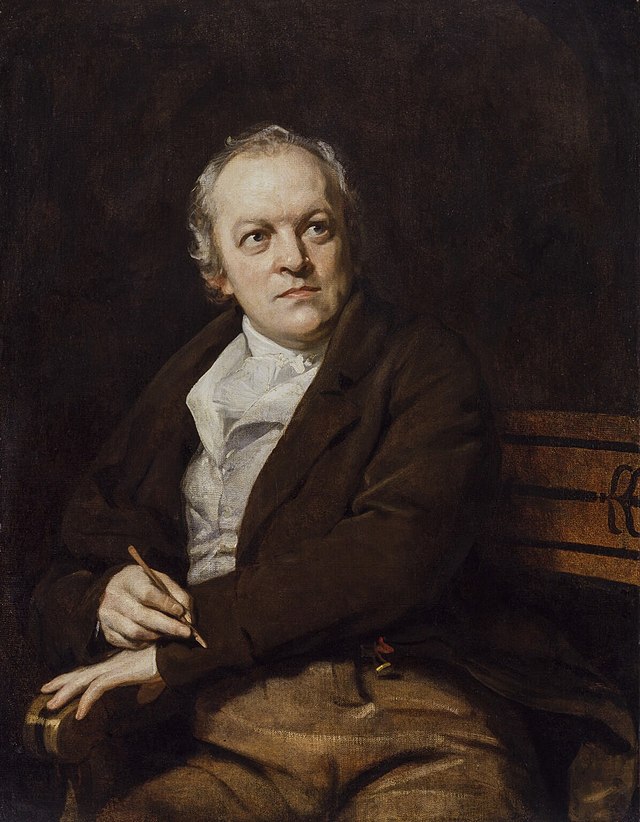
William Blake (28 November 1757 – 12 August 1827) was an English painter, poet and printmaker. Largely unrecognised during his lifetime, Blake is now considered a seminal figure in the history of the poetry and visual arts of the Romantic Age. His prophetic poetry has been said to form "what is in proportion to its merits the least read body of poetry in the English language".[2] His visual artistry led one contemporary art critic to proclaim him "far and away the greatest artist Britain has ever produced".

The Tiger

1757-1827


TIGER, tiger, burning bright 
In the forests of the night, 
What immortal hand or eye 
Could frame thy fearful symmetry? 

In what distant deeps or skies 
Burnt the fire of thine eyes? 
On what wings dare he aspire? 
What the hand dare seize the fire? 

And what shoulder and what art 
Could twist the sinews of thy heart? 
And when thy heart began to beat, 
What dread hand and what dread feet? 

What the hammer? what the chain? 
In what furnace was thy brain? 
What the anvil? What dread grasp 
Dare its deadly terrors clasp? 

When the stars threw down their spears, 
And water'd heaven with their tears, 
Did He smile His work to see? 
Did He who made the lamb make thee? 

Tiger, tiger, burning bright 
In the forests of the night, 
What immortal hand or eye 
Dare frame thy fearful symmetry? 

→ 讚美造物者: creator 
--------------------------------------


3) The Author to Her Book 
--- Anne Bradstreet
Thou ill-formed offspring of my feeble brain,
Who after birth didst by my side remain,
Till snatched from thence by friends, less wise than true,
Who thee abroad, exposed to public view,
Made thee in rags, halting to th’ press to trudge,
Where errors were not lessened (all may judge).
At thy return my blushing was not small,
My rambling brat (in print) should mother call,
I cast thee by as one unfit for light,
The visage was so irksome in my sight;
Yet being mine own, at length affection would
Thy blemishes amend, if so I could.
I washed thy face, but more defects I saw,
And rubbing off a spot still made a flaw.
I stretched thy joints to make thee even feet,
Yet still thou run’st more hobbling than is meet;
In better dress to trim thee was my mind,
But nought save homespun cloth i’ th’ house I find.
In this array ‘mongst vulgars may’st thou roam.
In critic’s hands beware thou dost not come,
And take thy way where yet thou art not known;
If for thy father asked, say thou hadst none;
And for thy mother, she alas is poor,
Which caused her thus to send thee out of door.
*female subjectivity
----------------------------------------
4) Sinners in the hands of an anger god
p.213 
1. puritanism : original sin/ predestiny/ inherit guilty
2. His (God) wrath (Achilles' wrath)
----------------------------------------
5) Poor Richard's Almanac (農民曆)
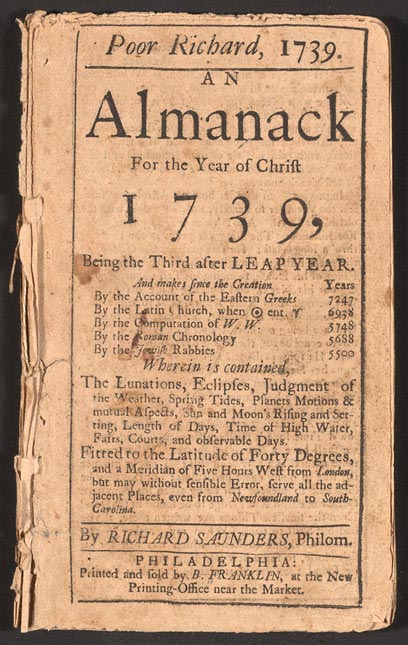
Poor Richard's Almanack (sometimes Almanac) was a yearly almanac published by Benjamin Franklin, who adopted the pseudonym of "Poor Richard" or "Richard Saunders" for this purpose. The publication appeared continually from 1732 to 1758. It was a best seller for a pamphlet published in the American colonies; print runs reached 10,000 per year.
*He is such a renaissance's man. (他很多才多藝)→ Benjamin Franklin
------------------------------------------------
6)The Treaty of Paris
The Treaty of Paris, signed in Paris by representatives of King George III of Great Britain and representatives of the United States of America on 3 September 1783, ended the American Revolutionary War. This treaty, along with the separate peace treaties between Great Britain and the nations that supported the American cause:France, Spain and the Dutch Republic, are known collectively as the Peace of Paris.[2][3] Its territorial provisions were "exceedingly generous" to the United States in terms of enlarged boundaries.
*NATO:The North Atlantic Treaty Organization (北大西洋公約)
-------------------------------------------
7)The Autobiography of Benjamin Franklin
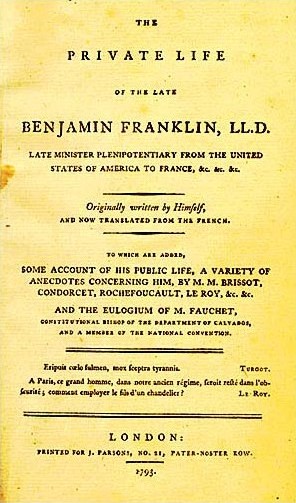
The Autobiography of Benjamin Franklin is the traditional name for the unfinished record of his own life written by Benjamin Franklin from 1771 to 1790; however, Franklin himself appears to have called the work his Memoirs. Although it had a tortuous publication history after Franklin's death, this work has become one of the most famous and influential examples of an autobiography ever written.
Franklin's account of his life is divided into four parts, reflecting the different periods at which he wrote them. There are actual breaks in the narrative between the first three parts, but Part Three's narrative continues into Part Four without an authorial break (only an editorial one).
*key words: Felicity/ Vanity
------------------------------------------------
8) Name of Virtues
In 1726, at the age of 20, Benjamin Franklin created a system to develop his character. In his autobiography, Franklin listed his thirteen virtues as:
  1. Temperance. Eat not to dullness; drink not to elevation.
  2. Silence. Speak not but what may benefit others or yourself; avoid trifling conversation.
  3. Order. Let all your things have their places; let each part of your business have its time.
  4. Resolution. Resolve to perform what you ought; perform without fail what you resolve.
  5. Frugality. Make no expense but to do good to others or yourself; i.e., waste nothing.
  6. Industry. Lose no time; be always employ'd in something useful; cut off all unnecessary actions.
  7. Sincerity. Use no hurtful deceit; think innocently and justly, and, if you speak, speak accordingly.
  8. Justice. Wrong none by doing injuries, or omitting the benefits that are your duty.
  9. Moderation. Avoid extremes; forbear resenting injuries so much as you think they deserve.
  10. Cleanliness. Tolerate no uncleanliness in body, cloaths, or habitation.
  11. Tranquillity. Be not disturbed at trifles, or at accidents common or unavoidable.
  12. Chastity. Rarely use venery but for health or offspring, never to dullness, weakness, or the injury of your own or another's peace or reputation.
  13. Humility. Imitate Jesus and Socrates.
--------------------------------------------------------
9) Thomas Jefferson
p.337
*He wished to be remembered for only three things: 
  • Drafting the Declaration of Independence, 
  • writing and supporting the Virginia Statute for Religious Freedom (1786), 
  • founding the University of Virginia
--------------------------------------------

10) The Thirteen Colonies(北美十三州)
The Thirteen Colonies were the British colonies on the Atlantic coast of North America founded between 1607 (Virginia) and 1733 (Georgia). Individual colonies began collaborating at the Albany Congress of 1754 to demand more rights and set up a Continental Congress in 1774 that declared independence from Great Britain in 1776 and formed a new nation, the United States of America. The thirteen colonies were: Delaware, Pennsylvania, New Jersey, Georgia, Connecticut, Massachusetts Bay,Maryland, South Carolina, New Hampshire, Virginia, New York, North Carolina, and Rhode Island and Providence Plantations.
 -------------------------------------------------
11) three brands of right
  • executive
  • judiciary
  • legislative
→ function: chaste (檢查), balance (平衡)
---------------------------------------------------------
12) Rip Van Winkle
*... When the weather is fair and settled, they are clothed in blue and purple, and print their bold outlines on the clear evening sky, but, sometimes, when the rest of the landscape is cloudless, they will gather a hood of gray vapors about their summits, which, in the last rays of the setting sun, will glow and light up like a crown of glory...
→ 英國的消漲
---------------------------------------------------------
13) short story
*美國文學的典型
*出現很多antihero
* 多描寫middle class
*盛行原因: 女性閱讀比率提高/ 雜誌興起
----------------------------------------------------------
Word:

1) detached: 疏離的、孤立的
2) as- : 星 (天文) 相關
*asterisk: 星型
*astronaut: 太空人
3) renovation :革新
   innovation : 創新(心)


2014年10月8日 星期三

2014. 10. 08 note: Transcendentalism (week 5)

Note:

1) Longfellow
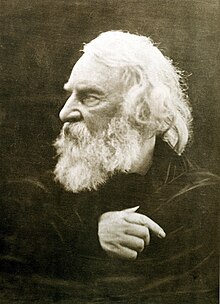
Henry Wadsworth Longfellow, photographed by Julia Margaret Cameron in 1868.jpg
Henry Wadsworth Longfellow (February 27, 1807 – March 24, 1882) was an American poet and educator whose works include "Paul Revere's Ride", The Song of Hiawatha, and Evangeline. He was also the first American to translate Dante Alighieri's The Divine Comedy and was one of the five Fireside Poets.

* A Psalm of Life
I
Tell me not, in mournful numbers,
Life is but an empty dream!
For the soul is dead that slumbers,
And things are not what they seem.
II
Life is real—life is earnest—
And the grave is not its goal:
Dust thou art, to dust returnest,
Was not spoken of the soul.
III
Not enjoyment, and not sorrow,
Is our destin'd end or way;
But to act, that each to-morrow
Find us farther than to-day.
IV
Art is long, and time is fleeting,
And our hearts, though stout and brave,
Still, like muffled drums, are beating
Funeral marches to the grave.
V
In the world's broad field of battle,
In the bivouac of Life,
Be not like dumb, driven cattle!
Be a hero in the strife!
VI
Trust no Future, howe'er pleasant!
Let the dead Past bury its dead!
Act—act in the glorious Present! (行在當下)
Heart within, and God o'er head!
VII
Lives of great men all remind us
We can make our lives sublime,
And, departing, leave behind us
Footprints on the sands of time. (sandglass/ hourglass → 沙漏)
VIII
Footprints, that, perhaps another,
Sailing o'er life's solemn main,
A forlorn and shipwreck'd brother,
Seeing, shall take heart again.
IX
Let us then be up and doing,
With a heart for any fate;
Still achieving, still pursuing,
Learn to labor and to wait.

*My Lost Truth (poem)
---- Henry Wadsworth Longfellow
"A boy's will is the wind's will,
And the thoughts of youth are long, long thoughts."

* Paul Revere's Ride (poem)

--------------------------------------


2) Grant Wood

Grant DeVolson Wood (February 13, 1891 – February 12, 1942) was an American painter born four miles (6 km) east of Anamosa, Iowa. He is best known for his paintings depicting the rural American Midwest, particularly the painting American Gothic, an iconic image of the 20th century.
-------------------------------------------------

3) Boston
From top left: The Boston skyline viewed from the Bunker Hill Monument, Museum of Fine Arts, Faneuil Hall, Massachusetts State House, The First Church of Christ, Scientist, Boston Public Library, John F. Kennedy Presidential Library and Museum, South Station, Boston University and the Charles River, Arnold Arboretum, Fenway Park, and Boston Common
Boston  the capital and largest city of the Commonwealth of Massachusetts in the United States. Boston also serves as county seat ofSuffolk County. The largest city in New England, the city proper, covering 48 square miles (124 km2), had an estimated population of 645,966 in 2014,[11] making it the 24th largest city in the United States.[4] The city is the anchor of a substantially larger metropolitan area called Greater Boston, home to 4.5 million people and thetenth-largest metropolitan area in the country.[7] Greater Boston as a commuting region[12] is home to 7.6 million people, making it the sixth-largest Combined Statistical Area in the United States.

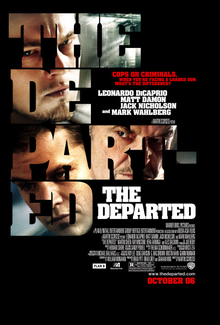
* The Departed (film)
 
The Departed is a 2006 American crime drama film directed by Martin Scorsese and written by William Monahan. It is a remake of the 2002 Hong Kong film Infernal Affairs.[2] The film stars Leonardo DiCaprio, Matt Damon, Jack Nicholson, and Mark Wahlberg, with Martin Sheen, Ray Winstone, Vera Farmiga, Anthony Anderson, and Alec Baldwin in supporting roles.
It won several awards, including four Oscars at the 79th Academy Awards: Best Picture, Best Director (Scorsese), Best Adapted Screenplay and Best Film Editing. Wahlberg was nominated for Best Supporting Actor.
The film takes place in Boston. 

*the Destruction of the Tea in Boston (波士頓茶葉黨事件)
Boston Tea Party w.jpg
The Boston Tea Party (initially referred to by John Adams as "the Destruction of the Tea in Boston"[2]) was a political protest by the Sons of Liberty in Boston, on December 16, 1773. The demonstrators, some disguised as American Indians, destroyed an entire shipment of tea sent by the East India Company, in defiance of the Tea Act of May 10, 1773. They boarded the ships and threw the chests of tea into Boston Harbor, ruining the tea. The British government responded harshly and the episode escalated into the American Revolution. The Tea Party became an iconic event of American history, and other political protests such as the Tea Party movement after 2010 explicitly refer to it.
----------------------------------------------------

4) Make way for Duckling
Make Way for Ducklings is a children's picture book written and illustrated by Robert McCloskey. First published in 1941, the book tells the story of a pair of mallardswho decide to raise their family on an island in the lagoon in Boston Public Garden, a park in the center of Boston.
Make Way for Ducklings won the 1942 Caldecott Medal for McCloskey's illustrations, executed in charcoal then lithographed on zinc plates. As of 2003, the book had sold over two million copies. The book's popularity led to the construction of a statue by Nancy Schön in the Public Garden of the mother duck and her eight ducklings, which is a popular destination for children and adults alike. In 1991, Barbara Bush gave a duplicate of this sculpture to Raisa Gorbachev as part of the START Treaty, and the work is displayed in Moscow's Novodevichy Park.

John Robert McCloskey (September 15, 1914 – June 30, 2003) was an American writer and illustrator of children's books. He both wrote and illustrated eight picture books and won two Caldecott Medals from the American Library Association recognizing the year's best-illustrated picture book. Four of those eight books were set in Maine: Blueberries for Sal, One Morning in Maine, Time of Wonder, and Burt Dow, Deep-water Man; the last three all on the coast. He was also the writer forMake Way For Ducklings, as well as the illustrator for The Man Who Lost His Head.
 ---------------------------------------

5) Breakfast at Tiffany 's (film)

Breakfast at Tiffany's is a 1961 American romantic comedy film starring Audrey Hepburn and George Peppard, and featuring Patricia Neal, Buddy Ebsen, Martin Balsam, and Mickey Rooney. The film was directed by Blake Edwards and released by Paramount Pictures. It is loosely based on the novella of the same name byTruman Capote.
----------------------------------------------

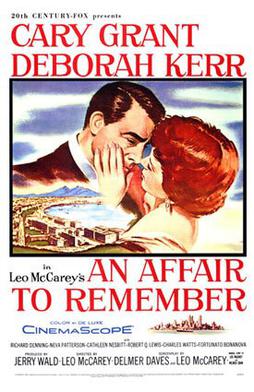
6) A affair to remember (film)

An Affair to Remember is a 1957 film starring Cary Grant and Deborah Kerr, and directed by Leo McCarey. It was distributed by 20th Century Fox. The film is considered one of the most romantic movies of all time, according to the American Film Institute.
*chick movie : 催淚電影
---------------------------------------------------

7) Nora Ephron  

Nora Ephron( May 19, 1941 – June 26, 2012) was an American journalist, essayist, playwright, screenwriter, novelist, producer, director, and blogger.
Ephron is best known for her romantic comedies and was nominated three times for the Academy Award for Best Writing: for Silkwood, When Harry Met Sally..., andSleepless in Seattle. She won a BAFTA Award for Best Original Screenplay for When Harry Met Sally.... She sometimes wrote with her sister Delia Ephron.[2] Her last film was Julie & Julia.[2] She also co-authored the Drama Desk Award–winning theatrical production Love, Loss, and What I Wore.[2][3] In 2013, Ephron received a posthumous Tony Award nomination for Best Play for her play Lucky Guy.
*電影中的紐約
---------------------------------------------------

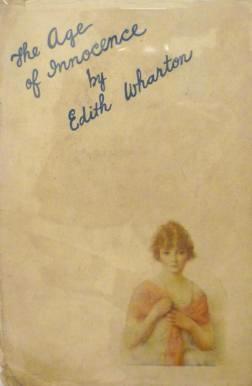
8)The Age of Innocence
The Age of Innocence is Edith Wharton' s twelfth novel, initially serialized in four parts in the Pictorial Review magazine in 1920, and later released by D. Appleton and Company as a book in New York and in London. It won the 1921 Pulitzer Prize for Fiction, making it the first novel written by a woman to win the Pulitzer Prize for Fiction, and thus Wharton the first woman to win the prize.[1] The story is set in upper-class New York City in the 1870s.
* 反映 inferiority complex(An inferiority complex is a lack of self-worth, a doubt and uncertainty, and feelings of not measuring up to standards.)

*Edith Wharton (alert/ observant)
Edith Wharton ( born Edith Newbold Jones; January 24, 1862 – August 11, 1937) was a Pulitzer Prize-winning American novelist, short story writer, and designer. She was nominated for the Nobel Prize in Literature in 1927, 1928 and 1930.[1] Wharton combined her insider's view of America's privileged classes with a brilliant, natural wit to write humorous, incisive novels and short stories of social and psychological insight. She was well acquainted with many of her era's other literary and public figures, including Theodore Roosevelt.
---------------------------------------------

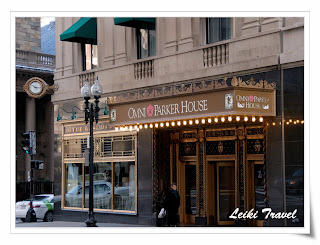
9) Parker House (波士頓派)

The Parker House has been an establishment for fine food and good times for 137 years.

------------------------------------------------

10) transcendentalism (higher faculty over-soul)
Transcendentalism is a religious and philosophical movement that developed during the late 1820s and '30s[1] in the Eastern region of the United States as a protest against the general state of spirituality and, in particular, the state of intellectualism at Harvard University and the doctrine of the Unitarian church as taught at Harvard Divinity School.
------------------------------------------------

11) Each and All  (poem)

"Nor knowest thou what argument thy life to thy neighbor's creed has lent. All are needed by each one; nothing is fair or good alone." 

Pine cones and acorns lay on the ground;


*古墓奇兵 (電影) : 一沙一世界
*朱熹: 願有源頭活水來
*John Donne : No man is an island
------------------------------------------------

12) Hillary Clinton
Hillary Diane Rodham Clinton ( born October 26, 1947) is a former United States Secretary of State, U.S. Senator, and First Lady of the United States. From 2009 to 2013, she was the 67th Secretary of State, serving under President Barack Obama. She previously represented New York in the U.S. Senate (2001 to 2009). Before that, as the wife of the 42nd President of the United States, Bill Clinton, she was First Lady from 1993 to 2001. In the 2008 election, Clinton was a leading candidate for the Democratic presidential nomination.

--------------------------------------------------

13)"Let the River Run" (song)
"Let the River Run" is a song first featured in the 1988 film Working Girl, with music and lyrics by Carly Simon.

*美國夢: 為達目的,無所不用其極
------------------------------------------------------

14) Art is long, Time is fleeting 
(from " A Psalm of  Life" )

→What we achieve in art, our writings, paintings, and music, will last long after we are dead. All of us, however vigorous, will die.