1.WHERE ARE YOU GOING, WHERE HAVE YOU BEEN?
Joyce Carol Oates
* the symbol of flies: Connie's suitors & Connie's mom's nag
----------
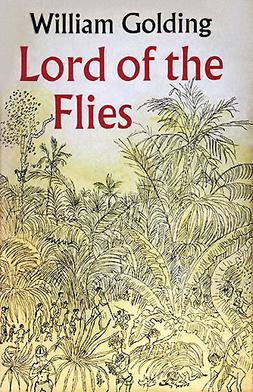
*Lord of the Flies is a 1954 dystopian novel by Nobel Prize-winning English author William Golding about a group of British boys stuck on an uninhabited island who try to govern themselves with disastrous results. Its stances on the already controversial subjects of human nature and individual welfare versus the common good earned it position 68 on the American Library Association’s list of the 100 most frequently challenged books of 1990–1999.[2] The novel is a reaction to the youth novel The Coral Island by R. M. Ballantyne.
*The book indicates that it takes place in the midst of an unspecified nuclear war. Some of the marooned characters are ordinary students, while others arrive as a musical choir under an established leader. Most (with the exception of the choirboys) appear never to have encountered one another before. The book portrays their descent into savagery; left to themselves in a paradisiacal country, far from modern civilisation, the well-educated children regress to a primitive state.
At an allegorical level, the central theme is the conflicting human impulses toward civilization—living by rules, peacefully and in harmony—and toward the will to power. Themes include the tension between groupthink and individuality, between rational and emotional reactions, and between morality and immorality. How these play out, and how different people feel the influences of these, form a major subtext of Lord of the Flies
---------3.Utopian and dystopian fiction
*The utopia and its offshoot, the dystopia, are genres of literature that explore social and political structures. Utopian fiction is the creation of an ideal society, or utopia, as the setting for a novel. Dystopian fiction (sometimes referred to as apocalyptic literature) is the opposite: creation of an utterly horrible or degraded society that is generally headed to an irreversible oblivion, or dystopia.
*Dystopian fiction
Dystopia is defined as a society characterized by a focus on mass poverty, squalor, suffering, or oppression, that society has most often brought upon itself.[1] Most authors of dystopian fiction explore at least one reason why things are that way, often as an analogy for similar issues in the real world. In the words of Keith M. Booker, dystopian literature is used to "provide fresh perspectives on problematic social and political practices that might otherwise be taken for granted or considered natural and inevitable".[3]-----------
4.Thomas More

*Utopia
A utopia is a community or society possessing highly desirable or near perfect qualities. The word was coined by Sir Thomas More in Latin for his 1516 book Utopia, describing a fictional island society in the Atlantic Ocean. The term has been used to describe both intentional communities that attempt to create an ideal society, and imagined societies portrayed in fiction. It has spawned other concepts, most prominently dystopia.
*The word comes from the Greek: οὐ("not") and τόπος ("place") and means "no place". The English homophone eutopia, derived from the Greek εὖ ("good" or "well") and τόπος ("place"), means "good place". This, because of the identical pronunciation of "utopia" and "eutopia", gives rise to a double meaning.
*The Republic (ca. 380 BC) by Plato - one of the earliest conceptions of a utopia.[24
→Books I–V: the eutopia portraying the ideal community and the education of the Guardians, parting from attempting to define justice;
-----------
5 the republic
.The Republic is a Socratic dialogue, written by Plato around 380 BC, concerning the definition ofδικαιοσύνη (justice), the order and character of the just city-state and the just man,[1] reason by which ancient readers used the name On Justice as an alternative title (not to be confused with the spurious dialogue also titled On Justice).[2] The dramatic date of the dialogue has been much debated and though it must take place some time during the Peloponnesian War, "there would be jarring anachronisms if any of the candidate specific dates between 432 and 404 were assigned".[3] It is Plato's best-known work and has proven to be one of the most intellectually and historically influential works of philosophy and political theory.[4][5] In it, Socrates along with various Athenians and foreigners discuss the meaning of justice and examine whether or not the just man is happier than the unjust man by considering a series of different cities coming into existence "in speech", culminating in a city (Kallipolis) ruled by philosopher-kings; and by examining the nature of existing regimes. The participants also discuss the theory of forms, the immortality of the soul, and the roles of the philosopher and of poetry in society.[6]
--------------
6. The Prince (君王論) -- Niccolo Machiavelli
→the king should be as cunning as a fox; as vicious as a lion (vise v.s virtue)
*The Prince is sometimes claimed to be one of the first works of modern philosophy, especially modern political philosophy, in which the effective truth is taken to be more important than any abstract ideal. It was also in direct conflict with the dominant Catholic and scholastic doctrines of the time concerning how to consider politics and ethics.
------------------
7. Neverland

Neverland is a fictional place featured in the works of J. M. Barrie and those based on them. It is the dwelling place of Peter Pan, Tinker Bell, the Lost Boys and others. Although not all people in Neverland cease to age, its best known resident famously refused to grow up, and it is often used as a metaphor for eternal childhood (and childishness), immortality, and escapism. It was first introduced as "the Never Never Land" in the theatre play Peter Pan, or The Boy Who Wouldn't Grow Upby Scottish writer J. M. Barrie, first staged in 1904.
*Lost Boys
The Lost Boys are a tribe of "children who fall out of their prams when the nurse is not looking",[5] and who, having not been claimed by humans in seven days, were collected by the fairies and flown to the Neverland. There are no "lost girls" because, as Peter explains, girls are much too clever to fall out of their prams and be lost in this manner. There are six Lost Boys: Tootles, Nibs, Slightly, Curly and the Twins. They are not permitted to fly by Peter, as it is a sign of his authority and uniqueness. They live in tree houses andcaves, wear animal skins, bear spears and bows and arrows, and live for adventure. They are a formidable fighting force despite their youth and they make war with the pirates, although they seem to enjoy a harmonious existence with the other inhabitants of Neverland. Their leader is Peter Pan, whom they call "father" in whose absence their activity and blood lust is diminished, and to whom they are completely loyal, fearful and adoring. The Lost Boys long for a mother, and they ask Wendy to take on the role. Following Peter's defeat of the pirates and commandeering of the Jolly Roger, they are adopted by Wendy's parents.
------------------8. Everland

Everland Resort is a theme park in Yongin, a city in Gyeonggi-do province, South Korea.
Everland is South Korea's largest theme park. With 6.6 million visitors, Everland ranked thirteenth in the world for amusement park attendance in 2011. Along with its main attractions, Everland also includes a zoo and a water park known as Caribbean Bay.
------------------
9. 三毛

三毛(英語:Echo,1943年3月26日-1991年1月4日),原名陳懋平、陳平,臺灣著名作家。出生於重慶,成長於台北。文化學院(今中國文化大學)哲學系肄業,是台灣70至80年代的著名作家。70年代以其在撒哈拉沙漠的生活及見聞為背景,以幽默的文筆發表充滿異國風情的散文作品成名,其讀者遍佈全世界華人社群。白先勇認為「三毛創造了一個充滿傳奇色彩瑰麗的浪漫世界;裡面有大起大落生死相許的愛情故事,引人入勝不可思議的異國情調,非洲沙漠的馳騁,拉丁美洲原始森林的探幽——這些常人所不能及的人生經驗造就了海峽兩岸的青春偶像[參 1]。」三毛於1991年住院時逝世。
*評論:
白先勇
「三毛自殺的消息傳來,大家都著實吃了一驚,我眼前似乎顯出了許多個不同面貌身份的三毛蒙太奇似的重疊在一起,最後通通淡出,只剩下那個穿著蘋果綠裙子十六歲驚惶羞怯的女孩——可能那才是真正的三毛,一個拒絕成長的生命流浪者,為了抵抗時間的凌遲,自行了斷,向時間老人提出了最後的抗議。」
-------------------
10.
Shall I compare thee to a summer’s day? (Sonnet 18)
Shall I compare thee to a summer’s day?
Thou art more lovely and more temperate.
Rough winds do shake the darling buds of May,
And summer’s lease hath all too short a date.
Sometime too hot the eye of heaven shines,
And often is his gold complexion dimmed;
And every fair from fair sometime declines,(美麗的事物總不免凋敗)
By chance, or nature’s changing course, untrimmed;(被機緣或自然的代謝摧殘)
But thy eternal summer shall not fade,
Nor lose possession of that fair thou ow’st,
Nor shall death brag thou wand’rest in his shade,
When in eternal lines to Time thou grow’st.
     So long as men can breathe, or eyes can see,
     So long lives this, and this gives life to thee.
---------------
11. Christianity
*monotheism(單一神論)←→ polytheism(多神論)
*afterlife:
In philosophy, religion, mythology, and fiction, the afterlife (also referred to as life after death or the Hereafter) is the concept of a realm, or the realm itself (whether physical or transcendental), in which an essential part of an individual's identity or consciousness continues to exist after the death of the body in the individual's lifetime. According to various ideas of the afterlife, the essential aspect of the individual that lives on after death may be some partial element, or the entire soul, of an individual, which carries with it and confers personal identity. Belief in an afterlife, which may be naturalistic or supernatural, is in contrast to the belief in oblivion after death.
→The afterlife in different metaphysical models
Many religions, whether they believe in the soul's existence in another world like Christianity, Islam and many pagan belief systems, or in reincarnation like many forms of Hinduism and Buddhism, believe that one's status in the afterlife is a reward or punishment for their conduct during life.
Reincarnation
Heaven and hell
Limbo
Purgatory
----------------
12.
The Saint (film)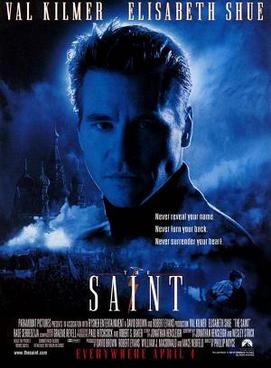
The Saint is a 1997 espionage thriller film, starring Val Kilmer in the title role, with Elisabeth Shue and Rade Šerbedžija, directed byPhillip Noyce and written by Jonathan Hensleigh and Wesley Strick. The title character is a high tech thief and master of disguise, that becomes the anti-hero while using the moniker of various saints while paradoxically living in the underworld of international industrial theft.
It is loosely based on the character of Simon Templar created by Leslie Charteris in 1928 for a series of books published as "The Saint", which ran until 1983. The Saint character has also featured in a series of Hollywood movies made between 1938 and 1954, a 1940s radio series starring Vincent Price (and others) as Templar, a popular British television series of the 1960s which starredRoger Moore, and a 1970s series starring Ian Ogilvy.
----------------
13. Apocalyptic literature→預世小說
*Apocalyptic literature is a genre of prophetical writing that developed in post-Exilic Jewish culture and was popular among millennialist early Christians.
*As a genre, apocalyptic literature details the authors' visions of the end times as revealed by a heavenly messenger or Angel.[2] The apocalyptic literature of Judaism and Christianity embraces a considerable period, from the centuries following the exile down to the close of the middle ages.
*For example: Book of Revelation

→The Book of Revelation, often known simply as Revelation or the Apocalypse,[1] is the final book of the New Testament and occupies a central place in Christian eschatology.
→ The author of the work identifies himself in the text as "John" and says that he was on Patmos, an island in the Aegean, when he was instructed by a heavenly figure to write down the contents of a vision. This John is traditionally supposed to be John the Apostle
---------------
14.The Hunger Game
 The Hunger Games universe is a dystopia set in North America where residents of different geographic regions are forced to participate in an annual televised death match called The Hunger Games.
→ a dystopian, post-apocalyptic fiction
13. Apocalyptic literature→預世小說
*Apocalyptic literature is a genre of prophetical writing that developed in post-Exilic Jewish culture and was popular among millennialist early Christians.
*As a genre, apocalyptic literature details the authors' visions of the end times as revealed by a heavenly messenger or Angel.[2] The apocalyptic literature of Judaism and Christianity embraces a considerable period, from the centuries following the exile down to the close of the middle ages.
*For example: Book of Revelation
→The Book of Revelation, often known simply as Revelation or the Apocalypse,[1] is the final book of the New Testament and occupies a central place in Christian eschatology.
→ The author of the work identifies himself in the text as "John" and says that he was on Patmos, an island in the Aegean, when he was instructed by a heavenly figure to write down the contents of a vision. This John is traditionally supposed to be John the Apostle
---------------
14.The Hunger Game
The Hunger Games universe is a dystopia set in North America where residents of different geographic regions are forced to participate in an annual televised death match called The Hunger Games.→ a dystopian, post-apocalyptic fiction
-----------------
15. The survival of the fittest.(適者生存): from the book, On the Origin of Species
*On the Origin of Species

On the Origin of Species, published on 24 November 1859, is a work of scientific literature by Charles Darwin which is considered to be the foundation of evolutionary biology.
* Natural Selection
Natural selection is the gradual process by which biological traits become either more or less common in a population as a function of the effect of inherited traits on the differential reproductive success of organisms interacting with their environment. It is a key mechanism of evolution. The term "natural selection" was popularized by Charles Darwin who intended it to be compared with artificial selection, now more commonly referred to as selective breeding.
Word
1. You never say never.
2. You're just sour grapes.
→妳就是酸葡萄心理
→妳就是酸葡萄心理


沒有留言:
張貼留言