1) 葉丙成 教授

*If you can rock your child, you can make him learn.
-----------------------------------------------------------
2) 少年pi的奇幻漂流

《少年Pi的奇幻漂流》(英語:Life of Pi),簡稱《奇幻漂流》,是2001年一部描述一名印度男孩「Pi」(音譯「派」)在太平洋上與成年孟加拉虎同船而撐過二百二十七天的生存故事,作者為加拿大作家楊·馬泰爾。2012年由李安所執導的同名電影上映。老虎的名字理察‧帕克是女王訴杜德利與史蒂芬案中,被同船船員殺害為食物的水手男孩的名字。
* theme: Who can survive?
←→ Ishmael (Moby Dick) : the only survivor of the Pequod's voyage
--------------------------------------------
3) Moby Dick

*Why should we read Moby Dick?
→ Lincoln's leadership/ dark leardership
*call me Ishmael
→passion/ prejudice/ ambition
*theme
dark power/ skepticism and hope/ existence/ democracy
people v,s, people, self, nature
---------------------------------------------------------
4) Herman Melville

Herman Melville (August 1, 1819 – September 28, 1891) was an American novelist, writer of short stories, and poet from the American Renaissance period. The bulk of his writings was published between 1846 and 1857. Best known for his sea adventure Typee (1846) and his whaling novel Moby-Dick (1851), he was almost forgotten during the last thirty years of his life. Melville's writing draws on his experience at sea as a common sailor, exploration of literature and philosophy, and engagement in the contradictions of American society in a period of rapid change. Melville's way of adapting what he read for his own new purposes, scholar Stanley T. Williams wrote, "was a transforming power comparable to Shakespeare's".
-----------------------------------------------
5) allegory
As a literary device, an allegory in its most general sense is an extended metaphor. Allegory has been used widely throughout the histories of all forms of art, largely because it readily illustrates complex ideas and concepts in ways that are comprehensible to its viewers, readers, or listeners. Allegories are typically used as literary devices or rhetorical devices that convey hidden meanings through symbolic figures, actions, imagery, and/or events, which together create the moral, spiritual, or political meaning the author wishes to convey.
For example: Fairie Queen
----------------------------------------------
6) Young Goodman Brown (initiation journey)

"Young Goodman Brown" is a short story published in 1835 by American writer Nathaniel Hawthorne. The story takes place in 17th century Puritan New England, a common setting for Hawthorne's works, and addresses the Calvinist/Puritan belief that all of humanity exists in a state of depravity, except those who are born in a state of grace. Hawthorne frequently attempts to expose the hypocrisy of Puritan culture in his literature. In a symbolic fashion, the story follows Young Goodman Brown's journey into self-scrutiny, which results in his loss of virtue and belief.
*pink ribbon: 純真的象徵
*allegory: city v.s. forest
----------------------------------------------
8) Allan Poe
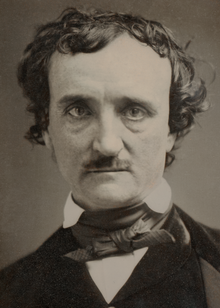
Edgar Allan Poe ( born Edgar Poe; January 19, 1809 – October 7, 1849) was an American author, poet, editor, and literary critic, considered part of the American Romantic Movement. Best known for his tales of mystery and the macabre, Poe was one of the earliest American practitioners of the short story, and is generally considered the inventor of the detective fiction genre. He is further credited with contributing to the emerging genre of science fiction.[1] He was the first well-known American writer to try to earn a living through writing alone, resulting in a financially difficult life and career.
*Philosophy of Composition
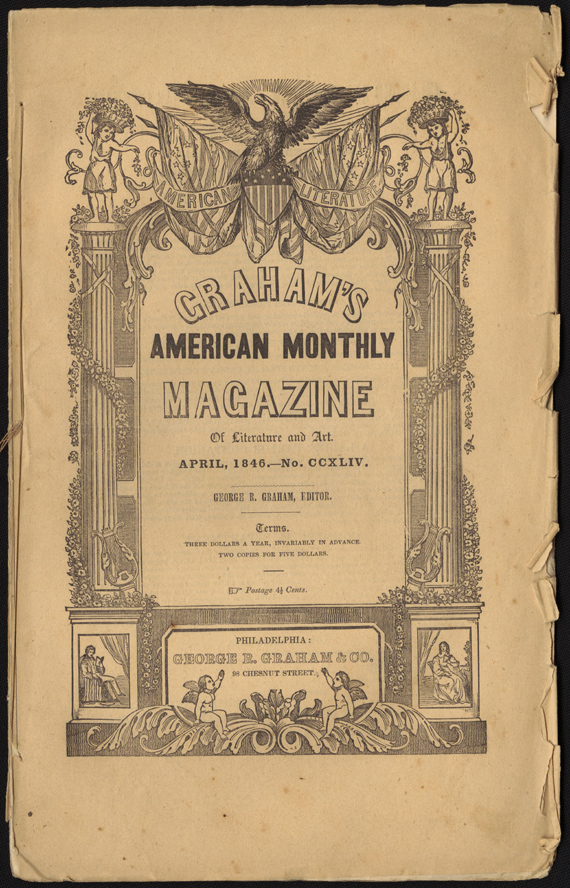
"The Philosophy of Composition" is an 1846 essay written by American writer Edgar Allan Poe that elucidates a theory about how good writers write when they write well. He concludes that length, "unity of effect" and a logical method are important considerations for good writing. He also makes the assertion that "the death... of a beautiful woman" is "unquestionably the most poetical topic in the world". Poe uses the composition of his own poem "The Raven" as an example. The essay first appeared in the April 1846 issue ofGraham's Magazine. It is uncertain if it is an authentic portrayal of Poe's own method.
→ brief/ melancholy/ didactic
----------------------------------------------
10)"Ode on a Grecian Urn"(古瓶頌)

"Ode on a Grecian Urn" is a poem written by the English Romantic poet John Keats in May 1819 and published anonymously in the January 1820, Number 15 issue of the magazine Annals of the Fine Arts (see 1820 in poetry).
* "Beauty is truth, truth beauty,—that is all
Ye know on earth, and all ye need to know."
--------------------------------------------
11) The Raven
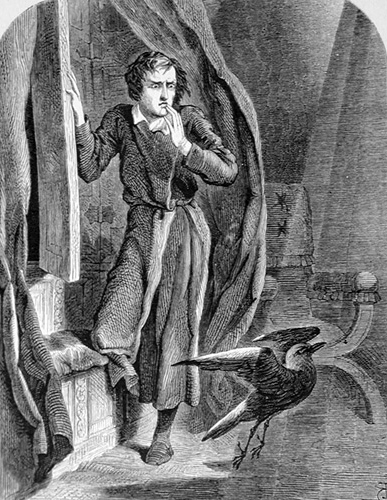
"The Raven" is a narrative poem by American writer Edgar Allan Poe. First published in January 1845, the poem is often noted for its musicality, stylized language, and supernaturalatmosphere. It tells of a talking raven's mysterious visit to a distraught lover, tracing the man's slow fall into madness. The lover, often identified as being a student,[1][2] is lamenting the loss of his love, Lenore. Sitting on a bust of Pallas, the raven seems to further instigate his distress with its constant repetition of the word "Nevermore". The poem makes use of a number of folk and classical references.
*被應用到高更的作品裡
PAUL GAUGUIN
NEVERMORE

Word:
1) epical: related to God, Hero, tragic flaw
2) mal- :hostile
*malignant: something bad
*malign: 誹謗
*malevolent ←→ benevolent

沒有留言:
張貼留言