1)introduction:
This is a survey course on American literature designed to train non-native students to read, understand, and appreciate the great books as well as the major literary genres of American literature from the poetry of Anne Bradstreet of the Colonial America to Tennessee Williams's A Streetcar Named Desire (play) for which he received the Pulitzer Prize for Drama in 1947, in the context of its cultural, historic, philosophical, political, artistic background and development.
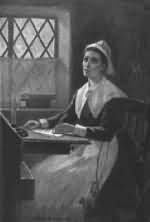 → Anne Bradstreet
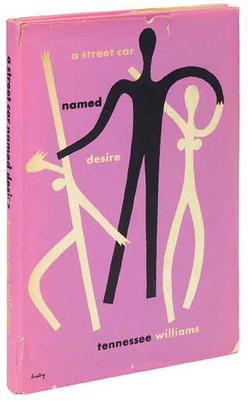 → A Street Car Named Desire
*some questions to be answered in the course
1) What is Literature?
2) Why people read Literature?
3) Why is it necessary for you to study Literature?
4) How to define American Literature? (analytical approach & historical approach)
5) Basic qualities of American Literature
6) How to study Literature?
----------------------------------------------
2) American Literature
American literature is the literature written or produced in the area of the United States and its preceding colonies. For more specific discussions of poetry and theater, see Poetry of the United States and Theater in the United States. During its early history, America was a series of British colonies on the eastern coast of the present-day United States. Therefore, its literary tradition begins as linked to the broader tradition of English literature. However, unique American characteristics and the breadth of its production usually now cause it to be considered a separate path and tradition.
*theme
1)independent
2)individualistic
3) critical
4) renovated
-------------------------------------------------
3) Christopher Columbus

Christopher Columbus ( born between 31 October 1450 and 30 October 1451, died 20 May 1506) was a Genoese explorer, navigator, and colonizer, born in the Republic of Genoa (today part of Italy). Under the auspices of the Catholic Monarchs of Spain, he completed four voyages across the Atlantic Ocean. Those voyages, and his efforts to establish permanent settlements on the island of Hispaniola, initiated the Spanish colonization of the New World.
*Christopher Columbus
Discovers America, 1492
→In the early modern period, the voyages of Christopher Columbus were a series of four voyages to the Americas between 1492 and 1502 that were led by the explorer Christopher Columbus. Columbus was an Italian navigator from the Republic of Genoa who became an admiral for the Spanish Crown, which sponsored these voyages. These voyages initiated European exploration andcolonization of the Americas and are thus of great significance in world history.
------------------------------------------------
3) William the Conquer

William I , usually known as William the Conqueror and sometimesWilliam the Bastard,[2][a] was the first Norman King of England, reigning from 1066 until his death in 1087. The descendant ofViking raiders, he had been Duke of Normandy since 1035 under the style William II. After a long struggle to establish his power, by 1060 his hold on Normandy was secure, and he launched the Norman conquest of England in 1066. The rest of his life was marked by struggles to consolidate his hold over England and his continental lands and by difficulties with his eldest son.
-------------------------------------------------
4)Short fiction and poetry
In the postwar period, the art of the short story again flourished. Among its most respected practitioners was Flannery O'Connor (b. March 25, 1925 in Georgia – d. August 3, 1964 in Georgia), who renewed the fascination of such giants as Faulkner and Twain with the American south, developing a distinctive Southern gothic esthetic wherein characters acted at one level as people and at another as symbols. A devout Catholic, O'Connor often imbued her stories, among them the widely studied "A Good Man is Hard to Find" and "Everything That Rises Must Converge", and two novels, Wise Blood (1952); The Violent Bear It Away (1960), with deeply religious themes, focusing particularly on the search for truth and religious skepticism against the backdrop of the nuclear age. Other important practitioners of the form include Katherine Anne Porter, Eudora Welty, John Cheever, Raymond Carver, Tobias Wolff, and the more experimental Donald Barthelme.
→ 美國文學最昌盛的文體: 短篇小說
--------------------------------------------------
5) Anne Bradstreet
Anne Bradstreet (born Anne Dudley; March 20, 1612 – September 16, 1672) was the most prominent of early English poets of North America and first female writer in the British North American colonies to be published. She was also a prominent Puritan figure in American Literature. Her first volume of poetry was The Tenth Muse Lately Sprung Up in America, published in 1650. It was met with a positive reception in both the Old World and the New World.[1][2]
*work
Bradstreet's education gave her advantages that allowed her to write with authority about politics, history, medicine, and theology. Her personal library of books was said to have numbered over 800, although many were destroyed when her home burned down. This event itself inspired a poem titled "Upon the Burning of Our House July 10th, 1666". She rejects the anger and grief that this worldly tragedy has caused her and instead looks toward God and the assurance of heaven as consolation, saying:
- "And when I could no longer look,
- I blest His grace that gave and took,
- That laid my goods now in the dust.
- Yea, so it was, and so 'twas just.
- It was his own; it was not mine.
- Far be it that I should repine."
6) Robert Frost
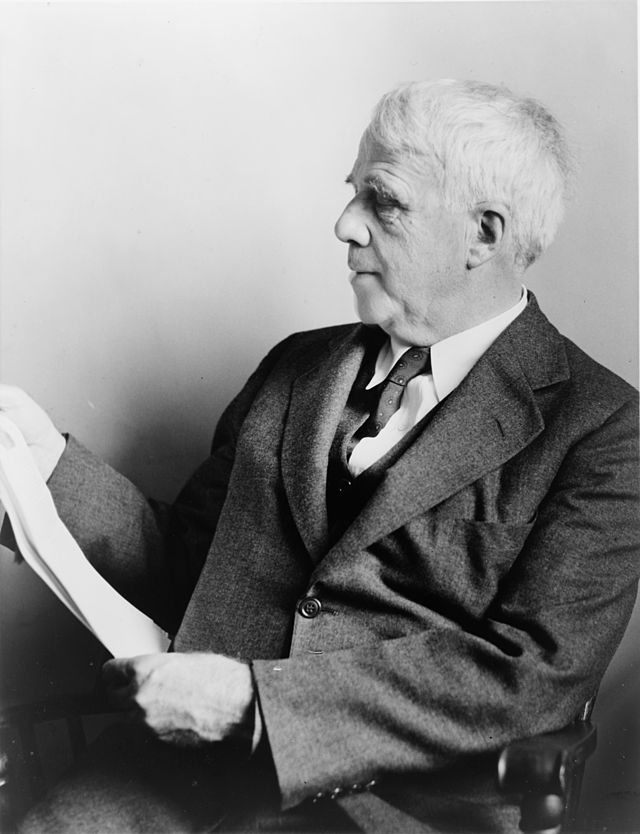
Robert Lee Frost (March 26, 1874 – January 29, 1963) was an American poet. His work was initially published in England before it was published in America. He is highly regarded for his realistic depictions of rural life and his command of American colloquial speech.[2] His work frequently employed settings from rural life in New England in the early twentieth century, using them to examine complex social and philosophical themes. One of the most popular and critically respected American poets of the twentieth century,[3] Frost was honored frequently during his lifetime, receiving four Pulitzer Prizes for Poetry. He became one of America's rare "public literary figures, almost an artistic institution." [3] He was awarded the Congressional Gold Medal in 1960 for his poetical works. On July 22, 1961 Frost was named Poet laureate of Vermont by the state legislature through Joint Resolution R-59 of the Acts of 1961, which also created the position.
-------------------------------------------------
7) Literature
It refers to artistic writings worthy of being remembered. In the broadest sense,
literature includes any type of writings on any subject: the literature of medicine;usually, however, it means the body of artistic writings of a country or period that are characterized by beauty of expression and form and by universality of intellectual
and emotional appeal: English literature of the 16th century. Belles lettres is a more specific term for writings of a light, elegant, or excessively refined
character: His talent is not for scholarship but for belles lettres.
Letters(rare today outside of certain fixed phrases) refers to literature as a domain of study or creation: a man of letters.
--------------------------------------
8)colonial period
Colonial history of the United States
The colonial history of the United States covers the history of European settlements from the start of colonization of America until their incorporation into the United States. In the late 16th century, England, France, Spain and the Netherlands launched major colonization programs in eastern North America. Small early attempts—such as the English Lost Colony of Roanoke—often disappeared; everywhere the death rate of the first arrivals was very high. Nevertheless successful colonies were established. European settlers came from a variety of social and religious groups. No aristocrats settled permanently, but a number of adventurers, soldiers, farmers, and tradesmen arrived. Diversity was an American characteristic as the Dutch of New Netherland, the Swedes and Finns of New Sweden, the English Quakers ofPennsylvania, the English Puritans of New England, the English settlers of Jamestown, and the "worthy poor" of Georgia, came to the new continent and built colonies with distinctive social, religious, political and economic styles. Non-British colonies were taken over and the inhabitants were all assimilated, unlike in Nova Scotia, where the British expelled the French Acadian inhabitants. There were no major civil wars among the 13 colonies, and the two chief armed rebellions (in Virginia in 1676 and in New York in 1689–91) were short-lived failures. Wars between the French and the British—the French and Indian Wars and Father Rale's War—were recurrent, and involved French support for Wabanaki Confederacy attacks on the frontiers. By 1760 France was defeated and the British seized its colonies.
*Virginia


→是為紀念Elizabeth (Virgin Queen) 而命名
---------------------------------------------------
9) Captain John Smith

John Smith, an English soldier and explorer, is famous for his role in the founding and settling of Jamestown, the first permanent English settlement in America.
Smith wrote many accounts of his experience in Virginia and New England, including The Generall Historie of Virginia, New England, and the Summer Isles. In these works, especially in his account of fighting off 200 Native Americans while using one as a shield, Smith provided early examples of the tall tale. Furthermore, his discussions of leadership and survival in the Virginia wilderness make him one of the first American writers to explore the themes of self-creation,practicality, industry, self-reliance, and cultural contact. In many ways, he is a precursor to Benjamin Franklin, Ralph Waldo Emerson, Walt Whitman, and Mark Twain.
-----------------------------------------
10)
National Treasure
國家寶藏( film)

National Treasure is a 2004 American adventure/heist film produced and released by Walt Disney Pictures. It was written by Jim Kouf, Ted Elliott, Terry Rossio,Cormac Wibberley, and Marianne Wibberley, produced by Jerry Bruckheimer, and directed by Jon Turteltaub. It is the first film in the National Treasure franchise and stars Nicolas Cage, Harvey Keitel, Jon Voight, Diane Kruger, Sean Bean, Justin Bartha, and Christopher Plummer.
---------------------------------------------
11)Rip Van Winkle

"Rip Van Winkle" is a short story by American author Washington Irving published in 1819 as well as the name of the story's fictional protagonist. Written while Irving was living inBirmingham, England, it was part of a collection entitled The Sketch Book of Geoffrey Crayon, Gent. Although the story is set in New York's Catskill Mountains, Irving later admitted, "When I wrote the story, I had never been on the Catskills."
* Hen Pecker 妻管嚴
--------------------------------------------------
11)Cast Away 浩劫重生

Cast Away is a 2000 American adventure drama film directed and produced by Robert Zemeckis and starring Tom Hanks as a FedEx employee stranded on anuninhabited island after his plane crashes in the South Pacific. The film depicts his attempts to survive on the island using remnants of his plane's cargo. The film was a critical and commercial success, and Hanks was nominated for Best Actor in a Leading Role at the 73rd Academy Awards for his performance.
-------------------------------------------
12) Puritanism
The Puritans were a group of English Protestants in the 16th and 17th centuries, including, but not limited to, English Calvinists. Puritanism in this sense was founded by John Calvin from the clergy shortly after the accession of Elizabeth I of England in 1558, as an activist movement within the Church of England.
In modern times, the word 'puritan' is often used to mean 'against pleasure'.[1] Historically, the word was used pejoratively to characterize the Protestant group as extremists, similar to the Cathars of France and, according to Thomas Fuller in his Church History, dated back to 1564. Archbishop Matthew Parker of that time used it and 'precisian' with the sense of the modern 'stickler'.
---------------------------------------------
1) pamphlet: 小冊子
2) stamp tax: 印花稅
3) de- 分開
e.g., diverse, divide, different

沒有留言:
張貼留言