1) Great awakening
The term Great Awakening can refer to several periods of religious revival in American religious history. Historians and theologians identify three or four waves of increased religious enthusiasm occurring between the early 18th century and the late 19th century. Each of these "Great Awakenings" was characterized by widespread revivals led byevangelical Protestant ministers, a sharp increase of interest in religion, a profound sense of conviction and redemption on the part of those affected, an increase in evangelical church membership, and the formation of new religious movements and denominations.
--------------------------------------
2) romanticism (後文藝復興)
Romanticism (also the Romantic era or the Romantic period) was an artistic, literary, and intellectual movement that originated in Europe toward the end of the 18th century and in most areas was at its peak in the approximate period from 1800 to 1850. Partly a reaction to the Industrial Revolution,[1] it was also a revolt against the aristocratic social and political norms of the Age of Enlightenment and a reaction against the scientific rationalization of nature.[2] It was embodied most strongly in the visual arts, music, and literature, but had a major impact on historiography,[3] education[4] and the natural sciences.[5] Its effect on politics was considerable and complex; while for much of the peak Romantic period it was associated with liberalism and radicalism, its long-term effect on the growth of nationalism was probably more significant. The intellectual historian Isaiah Berlin has referred to Romanticism as "the last great 'transvaluation of values' in modern history."
*feature
1. emotional
2. humanistic
3. individualistic
-------------------------------------------
3) time line of literature development
古典 → 黑暗 → 復興 → 新古典 → 浪漫 → 維多利亞 → 現代
*每個時期都是上一時期的反動
-------------------------------------------
4) The Common Sense
from Thomas Paine
*The best government is that which governs least. (管最少的政府就是最好的)
→ 最早是梭羅提出的
------------------------------------------
5) the tenth muse lately sprung up in america --- Anne Bradstreet
The Tenth Muse, lately Sprung up in America, or Several Poems Compiled with Great Variety of Wit and Learning, Full of Delight, Wherein especially is Contained a Complete Discourse and Description of the Four Elements, Constitutions, Ages of Man, Seasons of the Year, together with an exact Epitome of the Four Monarchies, viz., The Assyrian, Persian, Grecian, Roman, Also a Dialogue between Old England and New, concerning the late troubles. With divers other pleasand and serious Poems, By a Gentlewoman in those parts is a 1650 book of poetry by Anne Bradstreet. It was Bradstreet's only work published in her lifetime. Published purportedly without Bradstreet's knowledge, Bradstreet wrote to her publisher acknowledging that she knew of the publication. She was forced to pretend she was unaware of the publication until afterwards, or she would have risked harsh criticism. Bradstreet wrote the poem "The Author to Her Book" in 1666 when a second edition was contemplated. The book was published, without Bradstreet's knowledge, by the Rev. John Woodbridge. Woodbridge took the manuscript to England where it was published.
------------------------------------------
6)The Age of Reason
The Age of Reason; Being an Investigation of True and Fabulous Theology is an influential pamphlet written by English and American political activist Thomas Paine, following in the tradition of eighteenth-century British deism. It challenges institutionalized religion and the legitimacy of the Bible, the central text of Christianity. Published in three parts in 1794, 1795, and 1807, it was a best-seller in the United States, where it caused a short-lived deistic revival. British audiences, however, fearing increased political radicalism as a result of theFrench Revolution, received it with more hostility. The Age of Reason presents common deistic arguments; for example, it highlights what Paine saw as corruption of the ChristianChurch and criticizes its efforts to acquire political power. Paine advocates reason in the place of revelation, leading him to reject miracles and to view the Bible as an ordinary piece of literature rather than as a divinely inspired text. It promotes natural religion and argues for the existence of a creator-God.
------------------------------------------------
7) Al Gore Concession Speech

*quotes
1."Partisan feeling must yield to patriotism. I'm with you, Mr. President, and God bless you."
2."Not under man but under God and law. That's the ruling principle of American freedom, the source of our democratic liberties.
3.I know that many of my supporters are disappointed. I am too. But our disappointment must be overcome by our love of country.
4.And I say to our fellow members of the world community, let no one see this contest as a sign of American weakness. The strength of American democracy is shown most clearly through the difficulties it can overcome.
5. I particularly urge all who stood with us to unite behind our next president.
6. I'm looking forward to spending the holidays with family and old friends. I know I'll spend time in Tennessee and mend some fences, literally and figuratively.
7.In addition, tonight, for the sake of our unity of the people and the strength of our democracy, I offer my concession.(我在此宣佈參選失敗)
-----------------------------------
8) Benjamin Franklin
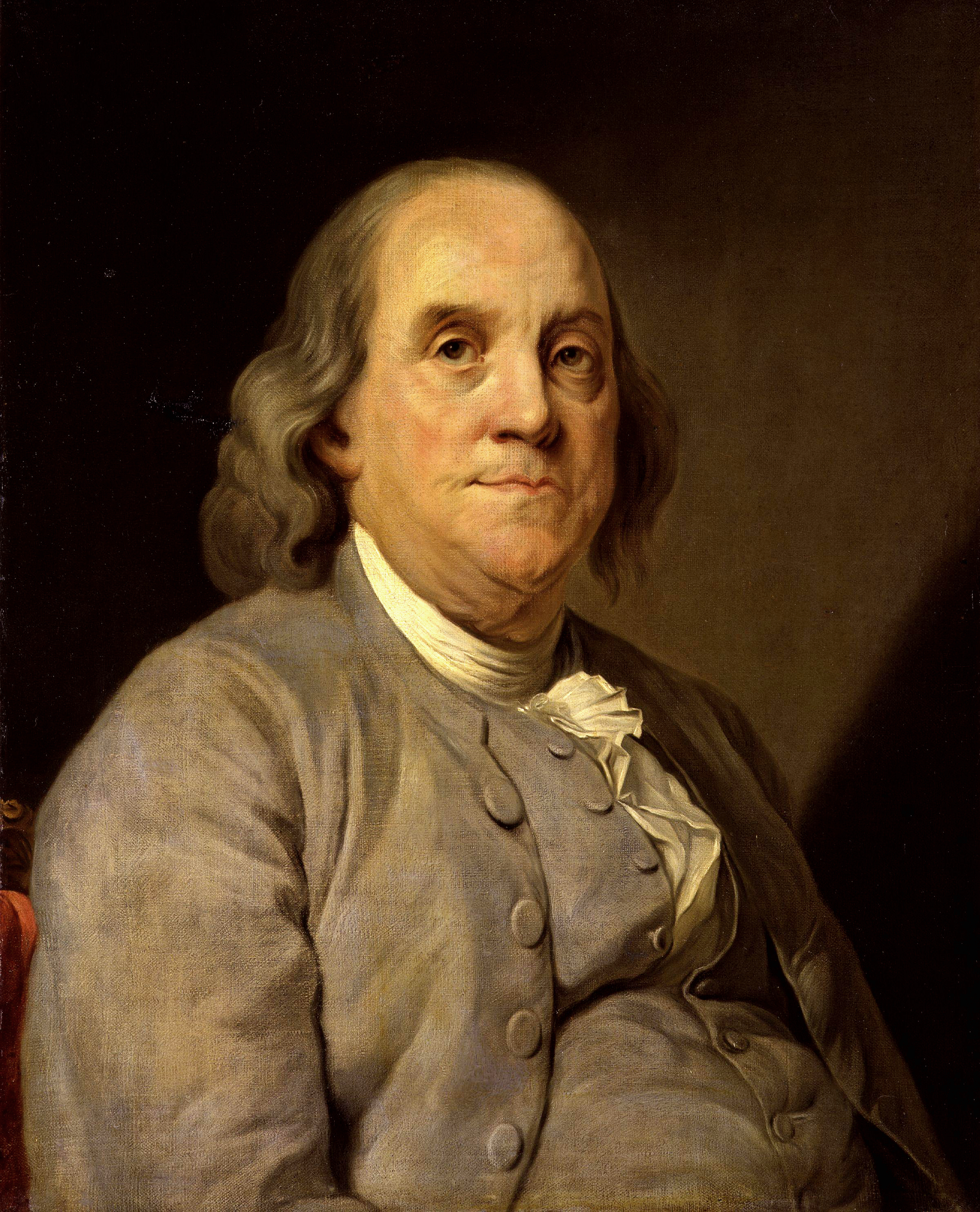
Benjamin Franklin (January 17, 1706 – April 17, 1790) was one of the Founding Fathers of the United States and in many ways was "the First American".[1] A renowned polymath, Franklin was a leading author, printer, political theorist, politician, postmaster, scientist, inventor, civic activist, statesman, and diplomat. As a scientist, he was a major figure in the American Enlightenment and the history of physics for his discoveries and theories regarding electricity. As an inventor, he is known for the lightning rod, bifocals, and the Franklin stove, among other inventions.[2] He facilitated many civic organizations, including Philadelphia's fire department and a university.
*名言
1. A penny saved is a penny earned.
2. The sleeping fox catches no poultry.
3. Time is money.
----------------------------------------------
9)Alexander Hamilton

Alexander Hamilton (January 11, 1755 or 1757 – July 12, 1804) was a founding father of the United States, chief staff aide to General George Washington, one of the most influential interpreters and promoters of the U.S. Constitution, the founder of the nation's financial system, and the founder of the first political party.
* The Federalist : written by Alexander Hamilton, John Jay, John Maidson
-----------------------------------------------
10) Manifest destiny
In the 19th century, Manifest Destiny was the widely held belief in the United States that American settlers were destined to expand throughout the continent. Historians have for the most part agreed that there are three basic themes to Manifest Destiny:
- The special virtues of the American people and their institutions;
- America's mission to redeem and remake the west in the image of agrarian America;
- An irresistible destiny to accomplish this essential duty.
-----------------------------------------------------
11) Territorial Expansion (西進政策)

This is a United States territorial acquisitions and conquests list, beginning with American independence. Note that this list primarily concerns land the United States acquired from other nation-states; the territorial acquisitions from Native Americans are not listed here.
----------------------------------------------------
12) Transcendentalism
Transcendentalism is a religious and philosophical movement that developed during the late 1820s and '30s in the Eastern region of the United States as a protest against the general state of spirituality and, in particular, the state of intellectualism at Harvard University and the doctrine of the Unitarian church as taught at Harvard Divinity School.
Among the transcendentalists' core beliefs was the inherent goodness of both people and nature. They believe that society and its institutions—particularly organized religion and political parties—ultimately corrupt the purity of the individual. They have faith that people are at their best when truly "self-reliant" and independent. It is only from such real individuals that true community could be formed.
-----------------------------------------------
Word:
1) referendum : 公民投票
2) man- : related to hands
*manual
*manipulate

沒有留言:
張貼留言